Journal
Published 5/8/2025
Published 5/6/2025
Published 5/7/2025
Published 5/8/2025
Published 5/16/2025
Published 5/27/2025
Published 6/25/2025
Published 7/18/2025
Published 10/21/2025
Published 12/19/2025
Published 2/2/2026
Published 2/5/2026
Published 2/11/2026
Published 2/16/2026
Published 5/30/2025
Published 2/25/2026
Published 3/2/2026
Published 10/3/2022
Published 3/23/2026
Published 3/25/2026
Published 4/9/2026
Published 4/13/2026
Published 5/4/2020
Published 4/23/2026
Published 4/29/2026
Published 5/7/2026
Published 5/13/2026
Published 5/19/2026
Published 5/26/2026
Published 11/1/2024
Published 10/12/2022
Published 6/12/2026
Published 10/1/2024
Published 6/24/2026
Published 7/3/2026
Published 11/1/2023
Published 7/17/2026
Published 7/20/2026
Published 8/5/2025
Published 11/17/2022
Published 8/6/2026
Published 11/6/2025
Published 11/7/2024
Published 11/5/2024
Published 11/3/2024
Published 8/6/2020
Published 8/6/2020
Published 8/6/2026
Published 8/6/2026
Published 8/6/2026
Published 8/6/2026
Published 1/4/2026
Published 9/5/2024
Published 9/7/2021
Published 1/1/2025
Published 2/2/2025
Published 8/17/2026
Published 8/24/2026
Published 9/1/2026
Published 8/20/2026
Published 9/9/2026
Published 10/22/2026
Published 10/30/2026
Published 11/5/2021
Published 11/5/2026
Published 11/11/2026
Frieze Abu Dhabi Feature: The Sultan's Candlestick - A 14th-Century Masterpiece Still in Use 650 Years Later
Published 06/11/2026
On 26 February 1988, the American interior designer William Rankin Crowder Jr and his husband, Joseph Hoesl, were photographed together in their North Carolina home. The room is filled with an eclectic collection of paintings and decorative objects, from Chinese scroll paintings to Indian miniatures.
Between them, on a low table, stands a candlestick holding a white candle. It was made more than six centuries earlier, during the great cultural flowering of the Mamluk period, sometimes described as the Islamic Renaissance.
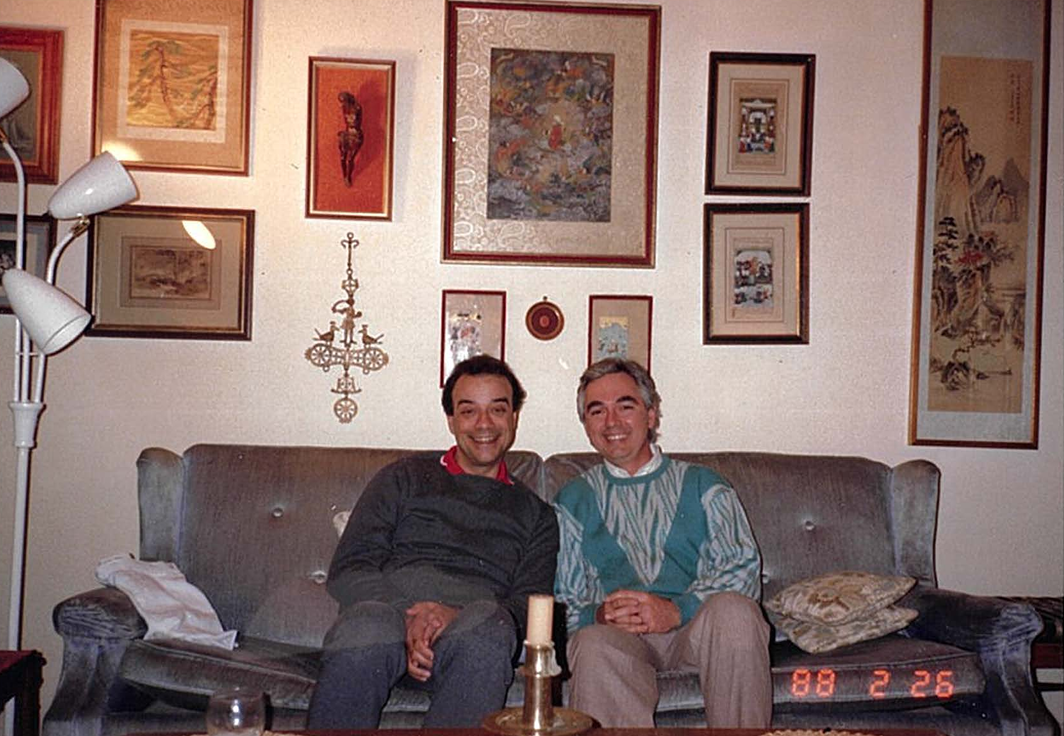
William Rankin Crowder Jr and Joseph Hoesl at home, 26 February 1988. The fourteenth-century Mamluk candlestick stands on the table between them.
The candlestick belongs to a distinctive group produced in Damascus for the Mamluk court during the fourteenth century. Most surviving examples carry inscriptions honouring powerful amirs, the senior military officers who served the sultan. The inscription on this candlestick honours the sultan himself, a distinction shared by only one other recorded example from the group, recorded in the Keir Collection.
The 1988 photograph provides a rare glimpse of the candlestick in use long after the dynasty it celebrated had disappeared. Its journey to North Carolina can be traced through the collection of the Greek theatre designer Andreas Nomikos.
From Andreas Nomikos to North Carolina
Andreas Nomikos (1917–1999) was born in Alexandria, Egypt, and studied law and political science at the University of Athens while taking painting lessons with the Greek artist Georges Gounaropoulos. He continued his artistic training at the Slade School of Fine Art in London.
During the Second World War, Nomikos returned to Greece, served in the Greek Resistance and later joined Greek forces in the Middle East and Italy. After the war, he developed a career in theatrical set and costume design, working with Karolos Koun’s Art Theatre and the Greek National Opera. In 1955, he designed for the Greek National Opera’s production of Idomeneo at the Odeon of Herodes Atticus, part of the newly established Athens Festival.
Nomikos settled in New York in the 1950s. In 1956, he became artistic director at the New York City Center Opera, designing for productions of works by Pirandello, Ibsen, Shaw and O’Neill. He later taught theatre at the University of North Carolina at Greensboro. Alongside his stage work, he continued to paint and make prints. The National Gallery in Athens held a retrospective of his monotypes and costume drawings in 1985.
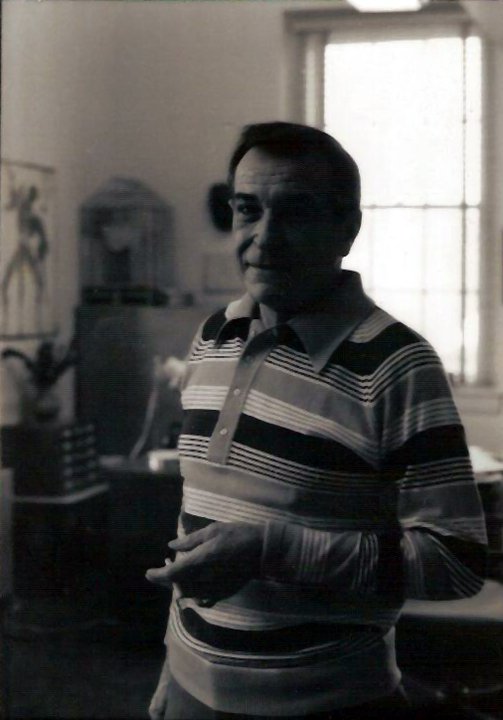
Andreas Nomikos (1917–1999), the Greek theatre designer and former owner of the candlestick.
In the late 1970s or early 1980s, certainly before 1983, Nomikos gave the candlestick to William Rankin Crowder Jr (1947–2021) and Joseph Hoesl.
Crowder studied at Greensboro College and at interior design schools in Washington and New York. He worked at the Franciscan Fabrics showroom in New York, where he was mentored by the designer Charles Dear. After a decade in the city, he established Crowder Designs in Greensboro with his brother, Gene W. Crowder, and Hoesl. The business brought antique and vintage furnishings into contemporary interiors and developed clients in the United States and abroad.
The candlestick was one of the objects Crowder and Hoesl incorporated into their own home. In the photograph dated 26 February 1988, its flaring base, broad drip terrace and tall socket are clearly identifiable beneath the candle. The image establishes its presence in their collection by that date and documents its continued domestic use more than 600 years after it was made.

William Rankin Crowder Jr (1947–2021), interior designer and later owner of the candlestick.
Following Crowder’s death in 2021, the candlestick passed by descent to his brother Gene W. Crowder in North Carolina. Checks against the Art Loss Register and INTERPOL Stolen Works of Art Database returned no corresponding record at the time of enquiry (ALR reference S00240449). The candlestick was published in David Aaron VIII in 2024.
The Mamluk Sultanate and an Islamic Renaissance
The candlestick was made under one of the great empires of the medieval Islamic world. Originally recruited and trained as enslaved warrior-soldiers, the Mamluks seized power in Egypt in 1250. They established a sultanate centred on Egypt and the Levant, with territories extending from south-eastern Anatolia to the Hijaz. Their rule continued until the Ottoman conquest of 1517.
Control of the trade routes connecting Europe with Asia brought enormous wealth to Cairo. Successive sultans invested in monumental architecture and the decorative arts. The resulting artistic flowering, sometimes described as an Islamic Renaissance, produced exceptional metalwork, glass, textiles, ceramics and manuscript illumination. These commissions celebrated the wealth and authority of the Mamluk ruling elite.
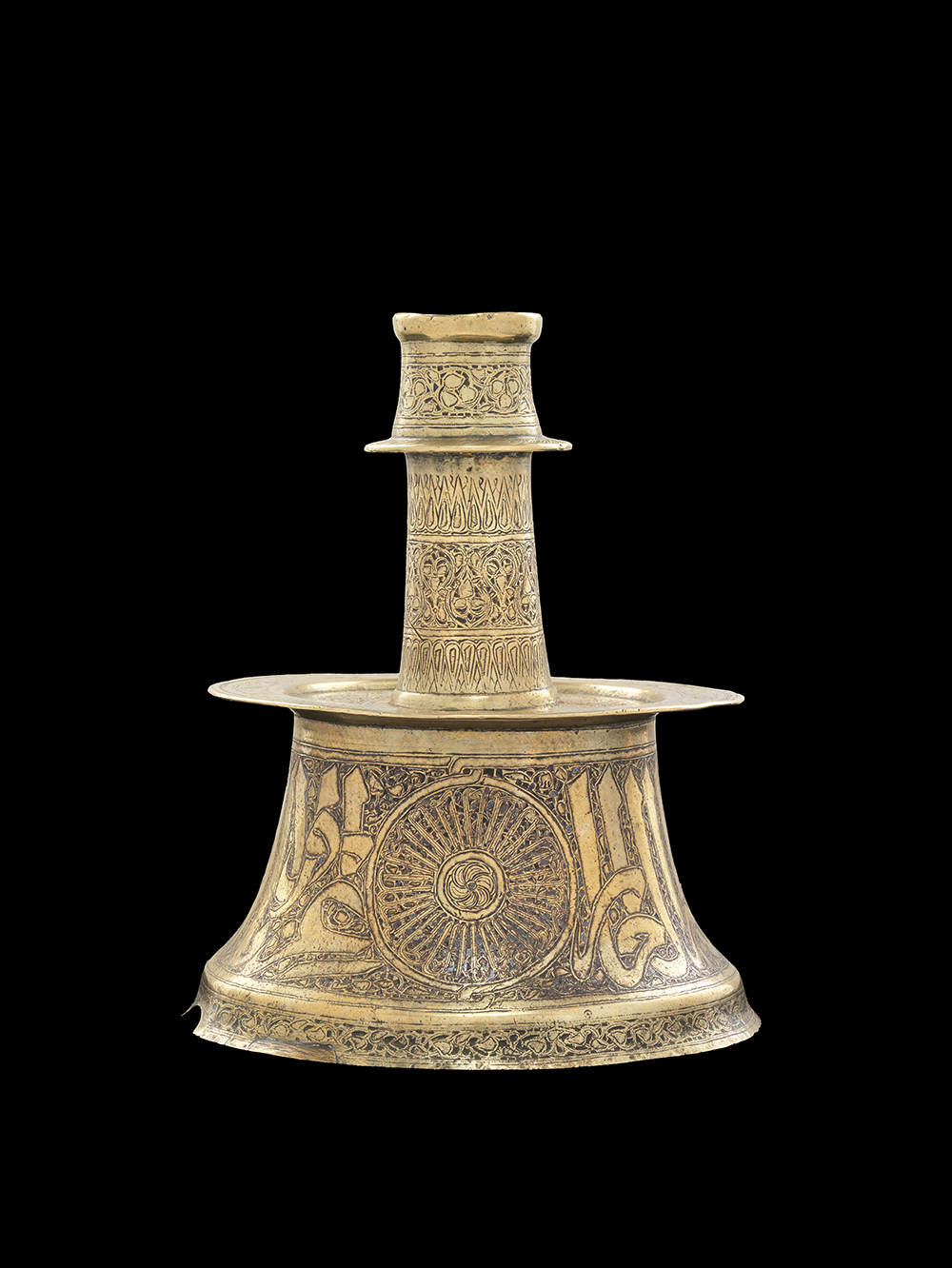
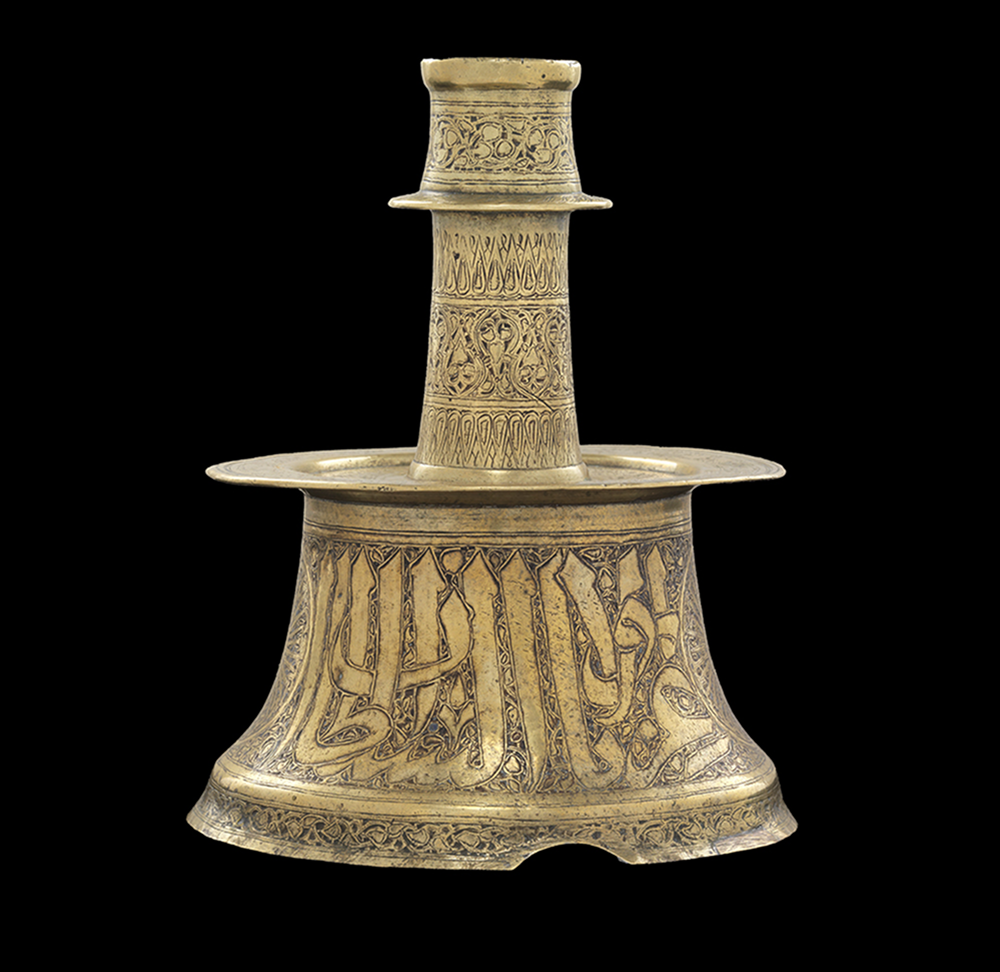
The Nomikos candlestick, Mamluk, fourteenth century. Brass with surviving traces of precious-metal inlay.
A Sultan Named in Brass

Detail of one radial inscription surrounding a six-petalled whirling rosette.
Two circular medallions dominate the candlestick’s flaring brass base. Its monumental Arabic inscriptions praise a ruler bearing the title al-Malik al-Nasir, or ‘the Victorious King’. The inscription around the body reads:
‘Glory to our Lord the Sultan al-Malik al-Nasir, the Wise.’
The radial inscriptions within the two medallions offer a longer acclamation:
‘Glory to our Lord the Sultan al-Malik al-Nasir, the wise, the industrious, the just, the holy warrior, the defender.’
The royal title was used by Sultan al-Nasir Muhammad ibn Qalawun, who ruled intermittently between 1293 and 1341, and later by his son Sultan al-Nasir Hasan, who reigned between 1347 and 1361, with an interruption.
Al-Nasir Muhammad was among the most prolific patrons of the arts in Mamluk history. He commissioned major architectural projects in Cairo and Jerusalem, while more than forty surviving metal vessels bear his name. His son continued the family’s architectural patronage, commissioning the vast mosque and madrasa of Sultan Hasan, one of Cairo’s most celebrated medieval buildings.
A related candlestick was made for Sayf al-Din Turji al-Saqi al-Nasiri, cupbearer to al-Nasir Muhammad, and bears the cup emblem associated with his office. Turji became an influential Mamluk official, leading the pilgrimage to Mecca in 1319 and 1325 before receiving further promotion. His candlestick illustrates the rank and status of the court officials for whom this form was ordinarily produced.
The calligraphy is integral to the design. Tall letters in thuluth script rise almost the full height of the base, interrupted by the two circular medallions. Within them, radial inscriptions spread around six-petalled whirling rosettes. This type of radial inscription appeared in Mamluk metalwork during the 1320s and provides an important clue to the candlestick’s date. Ward favours a narrower attribution to Damascus around 1325–1341.
The rosettes provide another connection to the ruling family. They were not formal Mamluk heraldic blazons, but frequently appeared on works commissioned for members and courtiers of the Qalawunid dynasty as signs of loyalty.
A Light in the Mamluk World
Cast in a single piece, the candlestick has a broad flaring base, a circular drip terrace and a tall cylindrical socket. Spiral grooves inside the socket allowed a separate shaft to be screwed into place when a taller candle support was needed.
This adaptable construction required the greater strength and stability of cast brass. Rare surviving extensions of this type are preserved in the Museum of Islamic Art in Doha.
The engraved surface was originally enriched with precious-metal inlay and dark organic material. Fine stippling on the main inscription suggests that its lettering was once overlaid with thin gold sheet. Much of the decoration has worn away, although small areas of silver and dark material remain within the foliate ornament. Pointed palmettes, leafy scrolls, flying birds and six-petalled rosettes complete the decoration of the neck and shoulder.
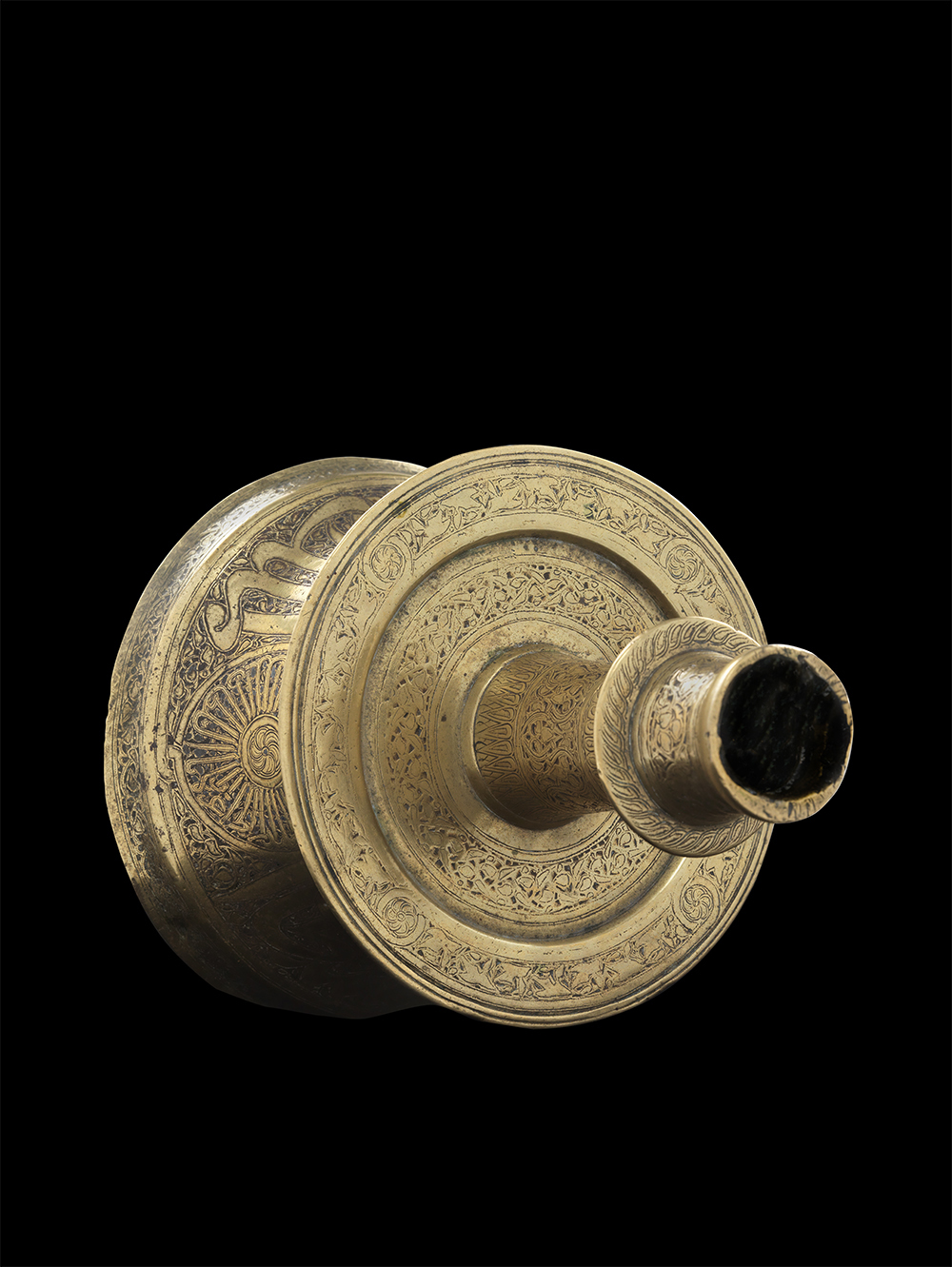
The circular drip terrace and engraved ornament surrounding the central socket.
A related archaeological discovery supports the attribution of this type of candlestick to Syrian workshops. Three comparable examples, two of them unfinished, were recovered from a shipwreck dated to around 1404 by coins from Syrian mints. The finds suggest that these cast candlesticks were manufactured in Syria, probably Damascus, even when destined for the Mamluk court in Cairo.
Wax was expensive in the medieval Islamic world, and elaborate metal candlesticks could be commissioned for religious foundations, ceremonial occasions and the homes of the ruling elite. The Nomikos candlestick’s elaborate decoration, unusual construction and royal inscriptions place it within this tradition of courtly metalwork.Its original commissioner is unknown.
In the photograph of Crowder and Hoesl’s home, the candlestick appears without its detachable extension, holding a single white candle. The inscriptions still proclaim the authority of a fourteenth-century sultan. More than six hundred years after it left a Damascene workshop, it was serving the purpose for which it had been made.


 Where to find us?
 Newsletter
 Instagram
 Linked in
 Email