Journal
Published 5/8/2025
Published 5/6/2025
Published 5/7/2025
Published 5/8/2025
Published 5/16/2025
Published 5/27/2025
Published 6/25/2025
Published 7/18/2025
Published 10/21/2025
Published 12/19/2025
Published 2/2/2026
Published 2/5/2026
Published 2/11/2026
Published 2/16/2026
Published 5/30/2025
Published 2/25/2026
Published 3/2/2026
Published 10/3/2022
Published 3/23/2026
Published 3/25/2026
Published 4/9/2026
Published 4/13/2026
Published 5/4/2020
Published 4/23/2026
Published 4/29/2026
Published 5/7/2026
Published 5/13/2026
Published 5/19/2026
Published 5/26/2026
Published 10/12/2022
Published 6/12/2026
Published 10/1/2024
Published 6/24/2026
Published 7/3/2026
Published 11/1/2023
Published 7/17/2026
Published 7/20/2026
Published 8/5/2025
Published 11/17/2022
Published 8/6/2026
Published 11/6/2025
Published 11/7/2024
Published 11/5/2024
Published 11/3/2024
Published 8/6/2020
Published 8/6/2020
Published 8/6/2026
Published 8/6/2026
Published 8/6/2026
Published 8/6/2026
Published 1/4/2026
Published 9/5/2024
Published 9/7/2021
Published 1/1/2025
Published 2/2/2025
Published 8/17/2026
Published 8/24/2026
Published 9/1/2026
Published 8/20/2026
Published 9/9/2026
Notable Sale: Mamluk Enamelled Glass Beaker acquired by Corning Museum of Glass
Published 01/11/2024

The exterior of the clear glass beaker is adorned with intricate enamel and gilt decoration. Blue, red, white, black, and green enamel is used to evoke a lively court scene of three seated musicians – one with a harp, one a lute, and another holding what may be a tambourine. The figures are divided by tall frond-like plants, and framed within a border of coursing hares above, and one of quatrefoils below, both picked out in blue.
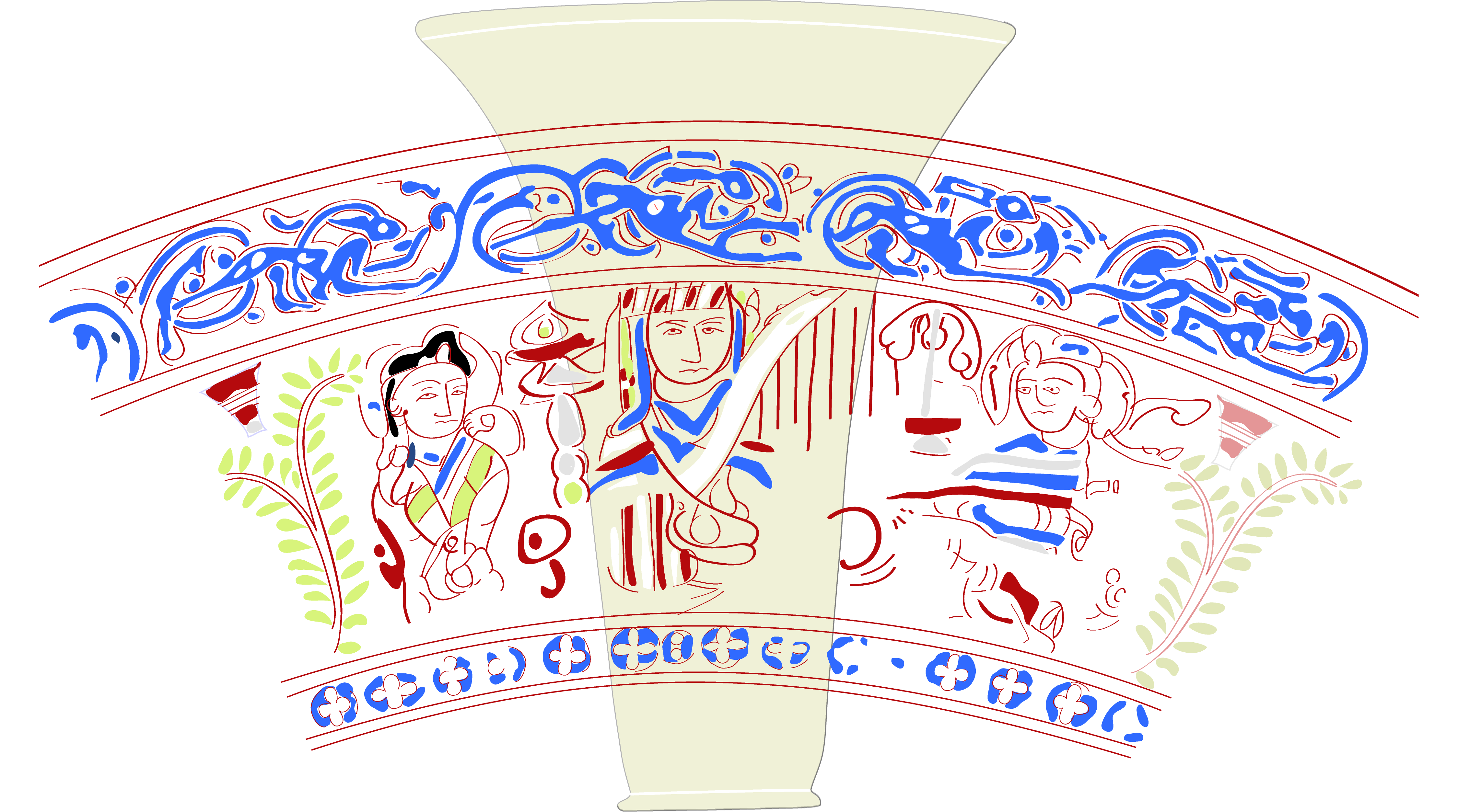 Illustrations of intricate enamel and gilt decoration
The vessel stands on a slightly protruding circular foot. The pontil mark on the centre of the underside indicates that the glass was hand blown; the thick, doughnut-like double layer of glass at the base is a common trait in Mamluk vessels of this kind. High-quality enamelled glass was produced in specialised workshops in the Ayyubid and Mamluk controlled regions of the thirteenth and fourteenth centuries (present-day Egypt and Syria). Coloured enamels were produced from powdered opaque glass that was applied to a vessel’s surface, often alongside gold, and then the whole piece was heated in a kiln to produce the richly coloured designs.
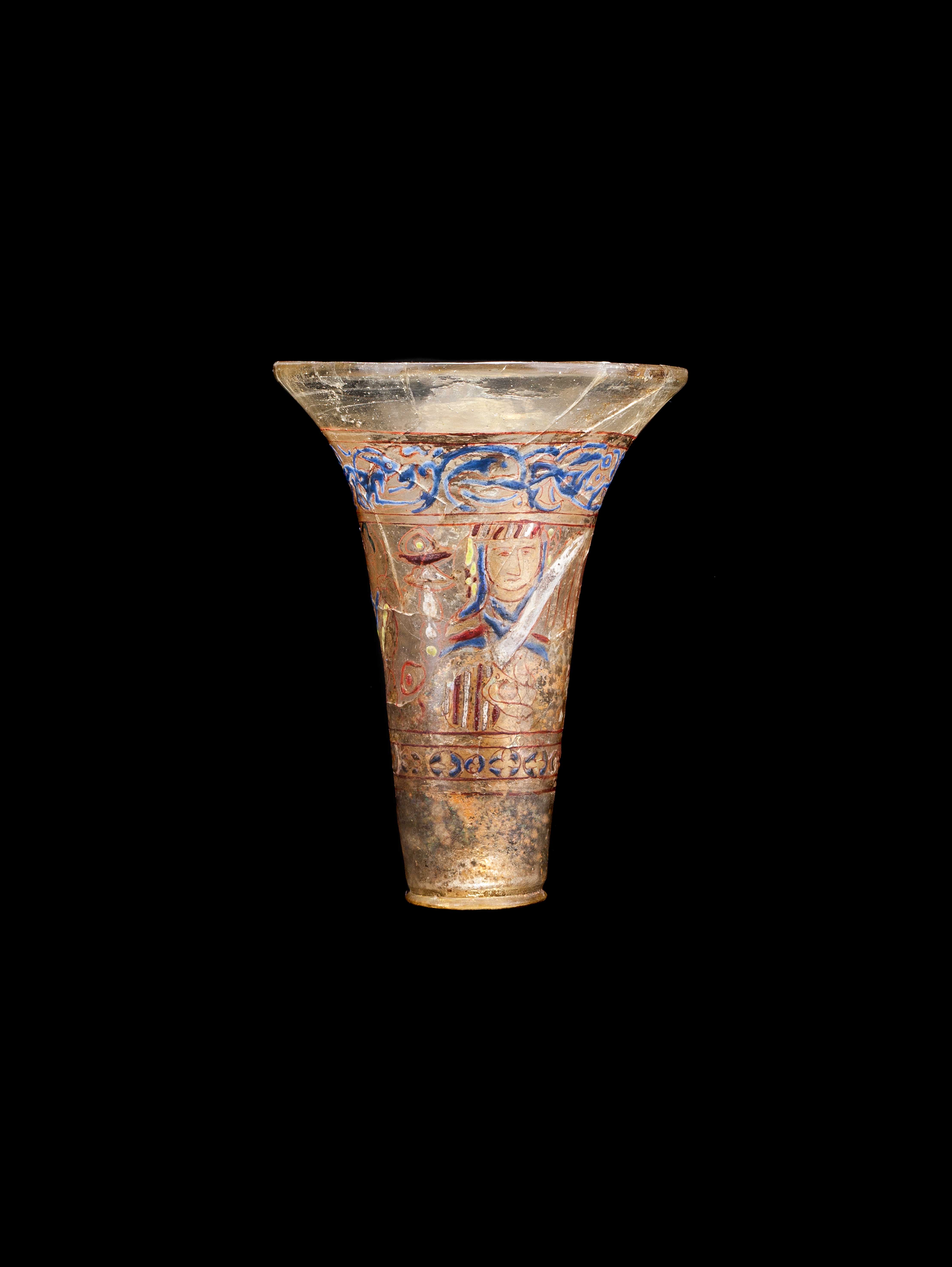
Mamluk Enamelled Glass Beaker, 13th century A.D. Image: David Brunetti
The technique was first developed in the twelfth century in the Syrian area, and flourished during the final decades of the Ayyubid dynasty (1171-1260) and the early Mamluk period in the thirteenth century. Following, Cairo’s selection as the Mamluk capital in the fourteenth century, most enamelled and gilded glass would have been produced in Egyptian workshops. The vast number of surviving fragments of Mamluk glass demonstrate its popularity and appeal – enamelled glassware must have been produced for commercial as well as noble clients. Moving forwards into the end of the fourteenth and early fifteenth centuries, dwindling patronage led to the closure of the Mamluk glass workshops, marking the end of Islamic artisans’ domination of enamelled glass production.
Illustriously Illustrated
This beaker has been extensively published since at least 1927, when it was discussed by Swedish-American polymath and curator at the California Academy of Sciences, Gustav Eisen. It was later published by Swedish art historian Carl Johan Lamm, who classed the beaker within his ‘Damascus group’.
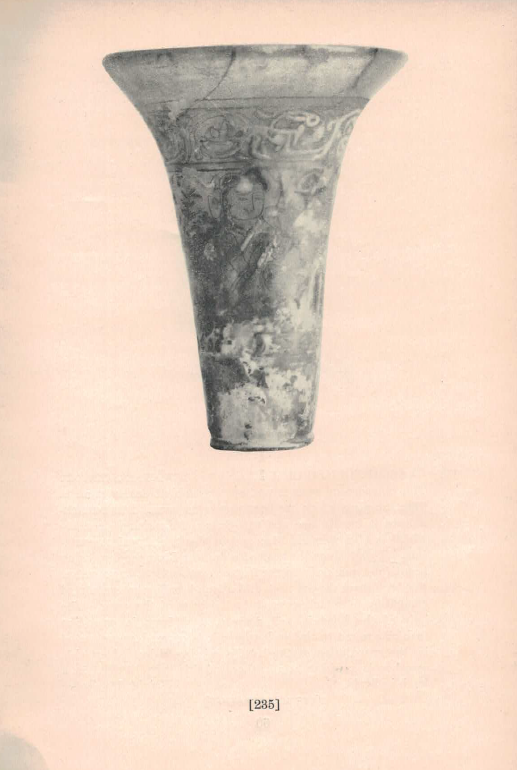
The Collection of Kouchakji Frères, Anderson Galleries, New York, 23rd January, 1927, lot 235.
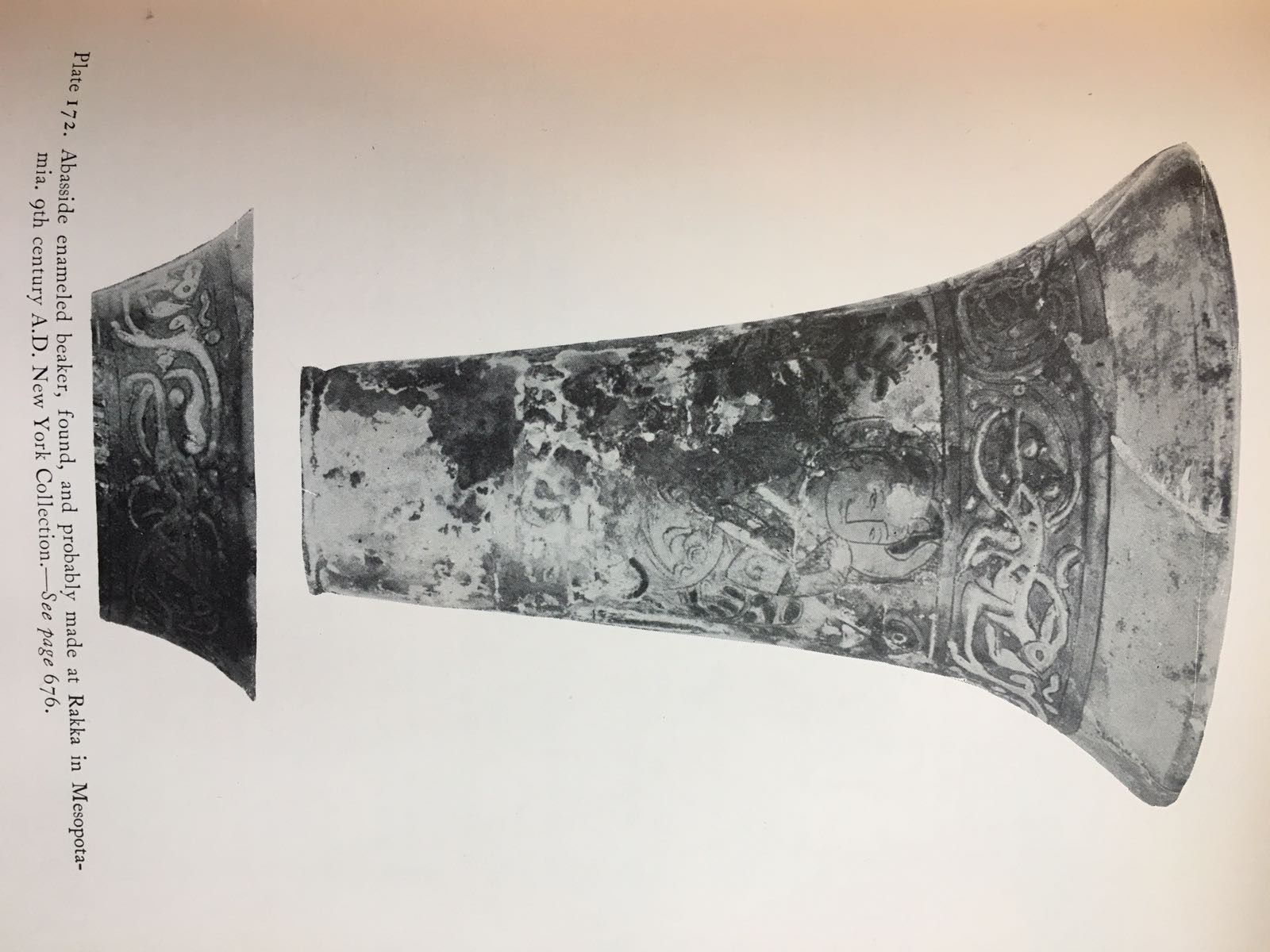
Gustavus A. Eisen and Fahim Kouchakji, Glass: Its Origin, History, Chronology, Technic and Classification to the Sixteenth Century (New York, 1927), vol. II, p. 676, pl. 172.
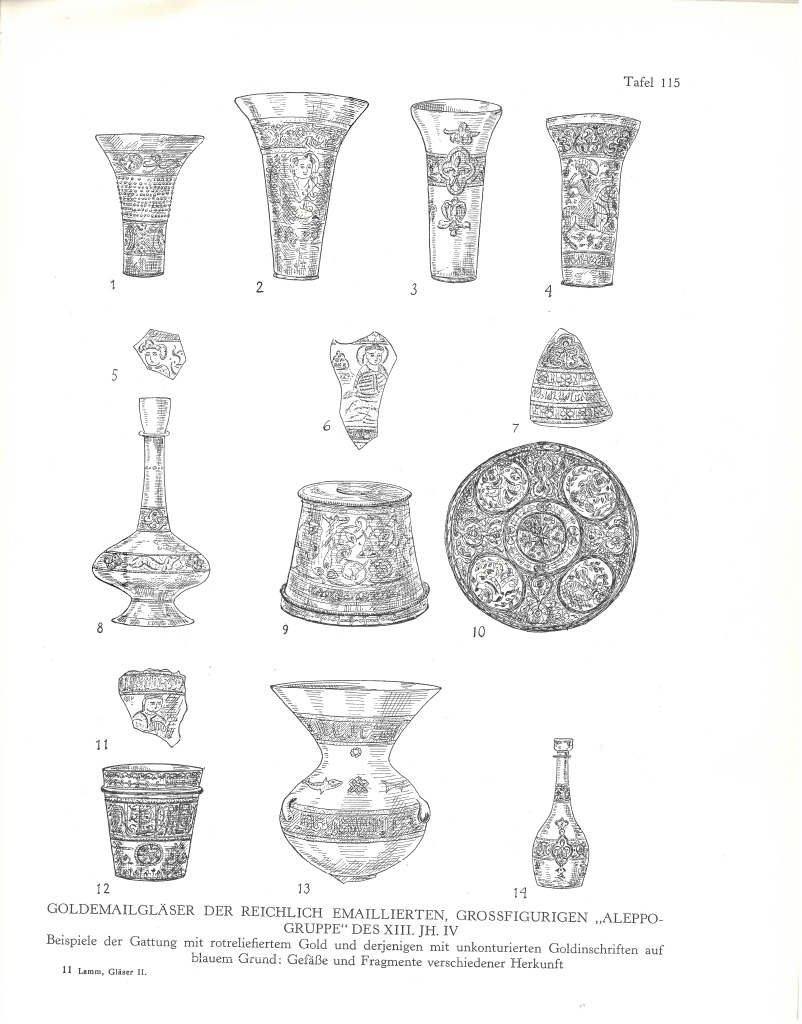
Carl Johan Lamm, Mittelalterliche Gläser und Steinschnittarbeiten aus dem Nahen Osten, (Berlin, 1929-30), vol. II, pl. 115, fig. 2.
This group features other highly notable examples of Mamluk enamelled glass, including a glass bucket or finger-bowl from the Rothschild collection which sold at Sotheby’s for over £1.5 million in 2009. Another work previously in the Rothschild collection presents a strong comparison with this beaker: an Ayyubid goblet on a later silver mount, known as the ‘Palmer Cup’, now in the British Museum (WB.53). Like the beaker, the goblet depicts a festive courtly scene framed within twining blue borders, and is a similarly rare and finely executed example of Islamic enamelled glass.
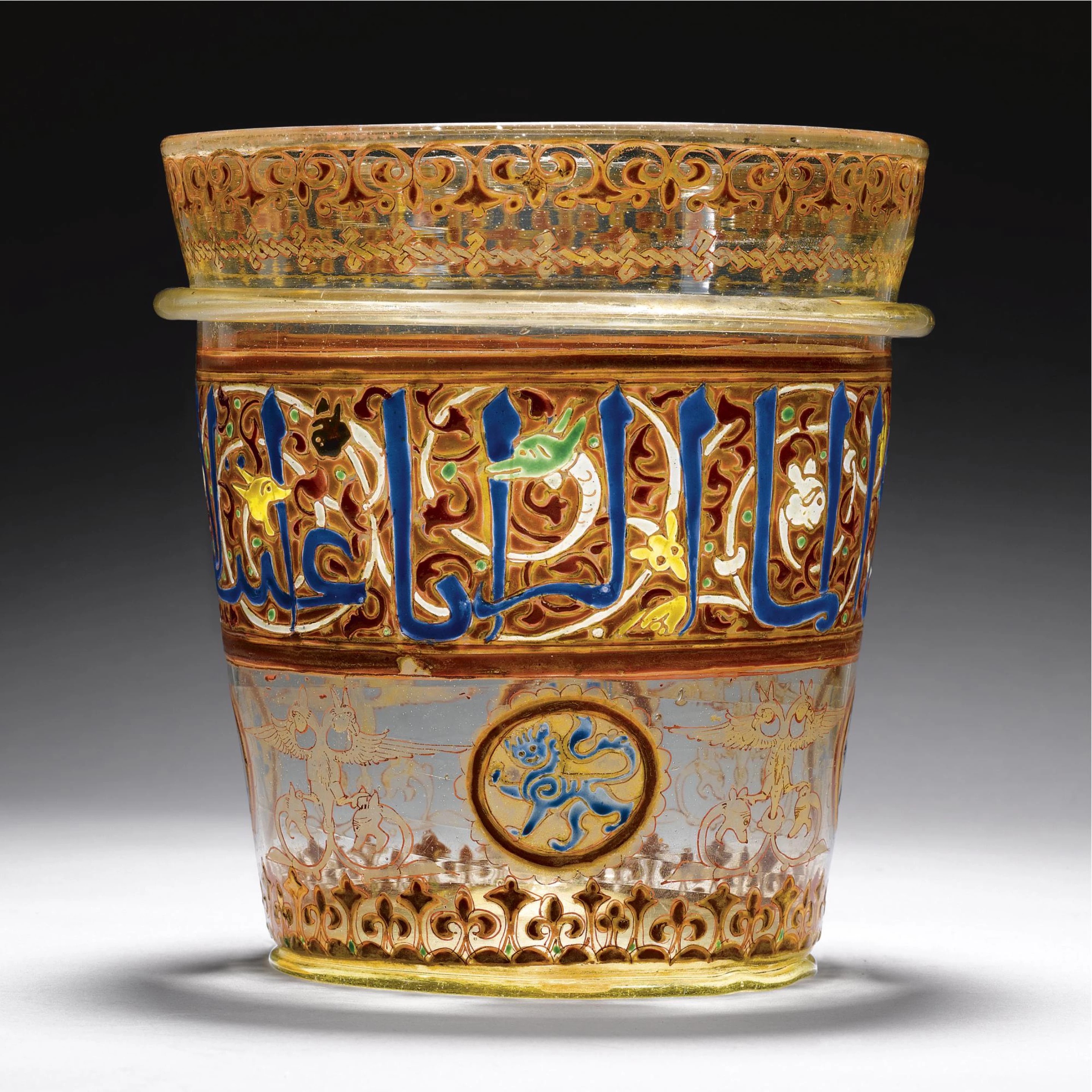
Mamluk glass bucket, mid-14th century, Sothebys
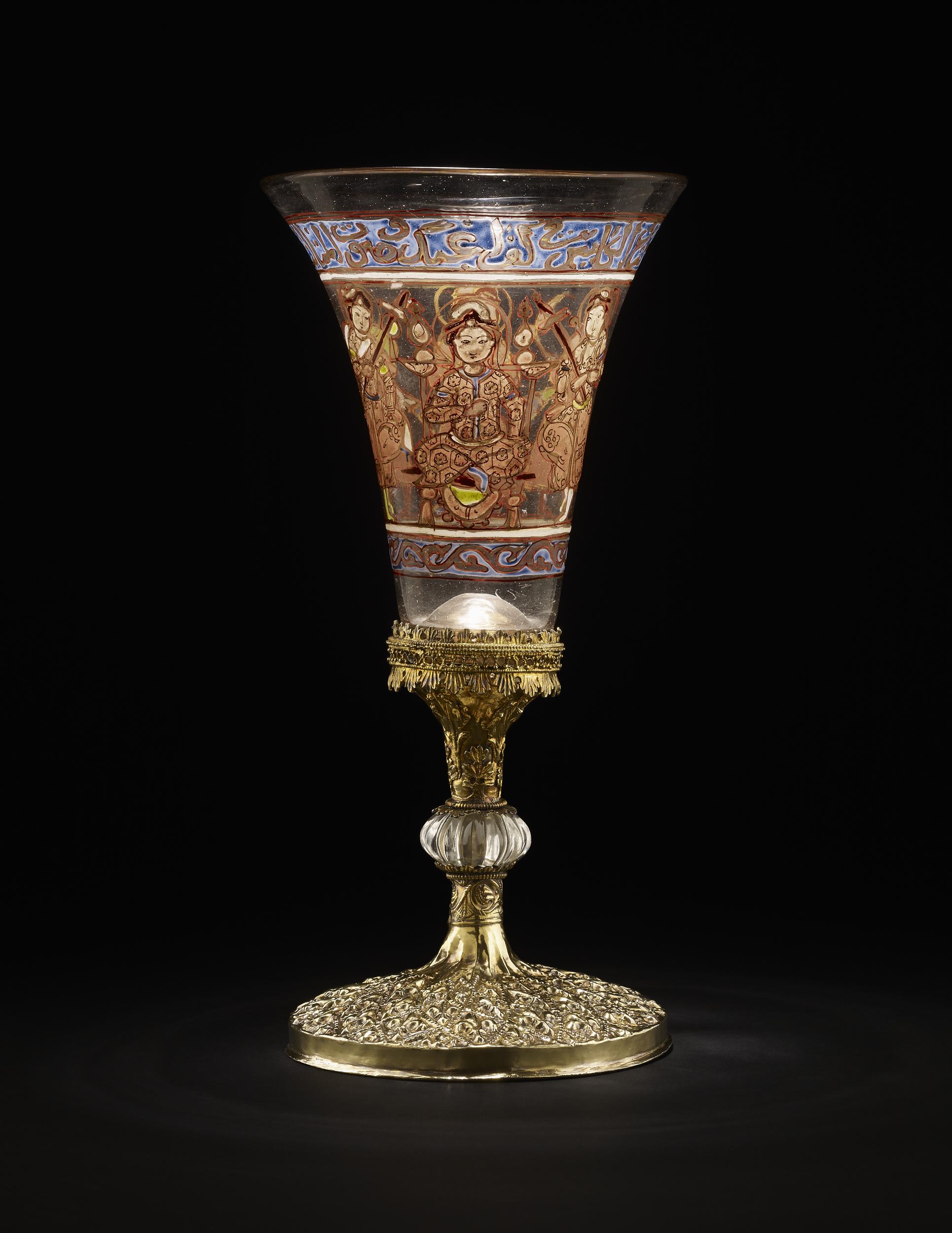
Goblet, 1201-1250 (circa (glass)), 14thC (mount), © The Trustees of the British Museum.
Interestingly, a 1918 catalogue of a sale of the Kouchakji Frères collection features a glass beaker that is incredibly similar to this example. With the same dimensions, colour scheme, and motifs, it is possible that the beakers were originally part of a pair or set of glasses. It is also possible that this is, in fact, the same beaker as that now with the Corning Museum and the subtle differences in design are the result of later restorations. It is a testament to the quality of the beaker that it has been illustrated in each of the publications and catalogues that it has featured in throughout the twentieth century.
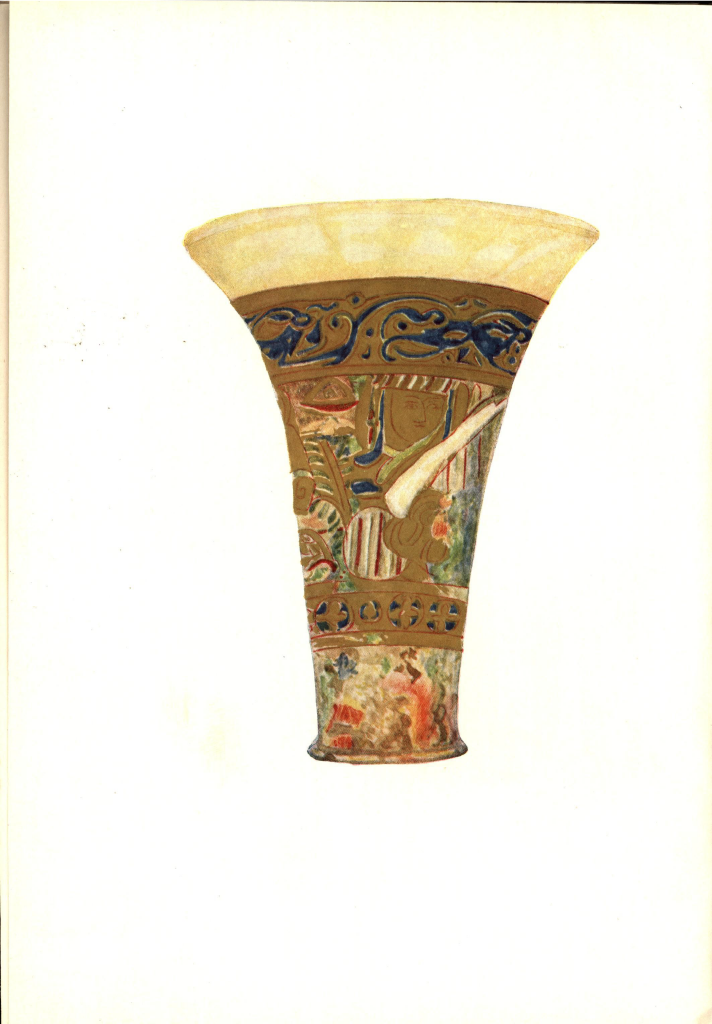
A similar beaker, The Kouchakji Frères Collection, American Art Galleries, New York, 8th-9th March 1918, lot 282, frontispiece.
A Connoisseurly Collector
After leaving the Kouchakji collection in 1977, the beaker appears at a later Sotheby’s sale, before making its way into the hands of Iranian collector Saeed Motamed. Famous for his highly considered taste and interest in Islamic art, with particular focus on early Islamic glass and Persian lacquerware, Motamed gathered a collection of over 1,000 objects from 1953 until his death in 2013. Many pieces from his collection are now in museums around the world, including several Islamic glasswares now in the British Museum (1978,1011.2, 1969,0317.2, 1967,0214.1, 1964,1217.2, 1978,1011.1).
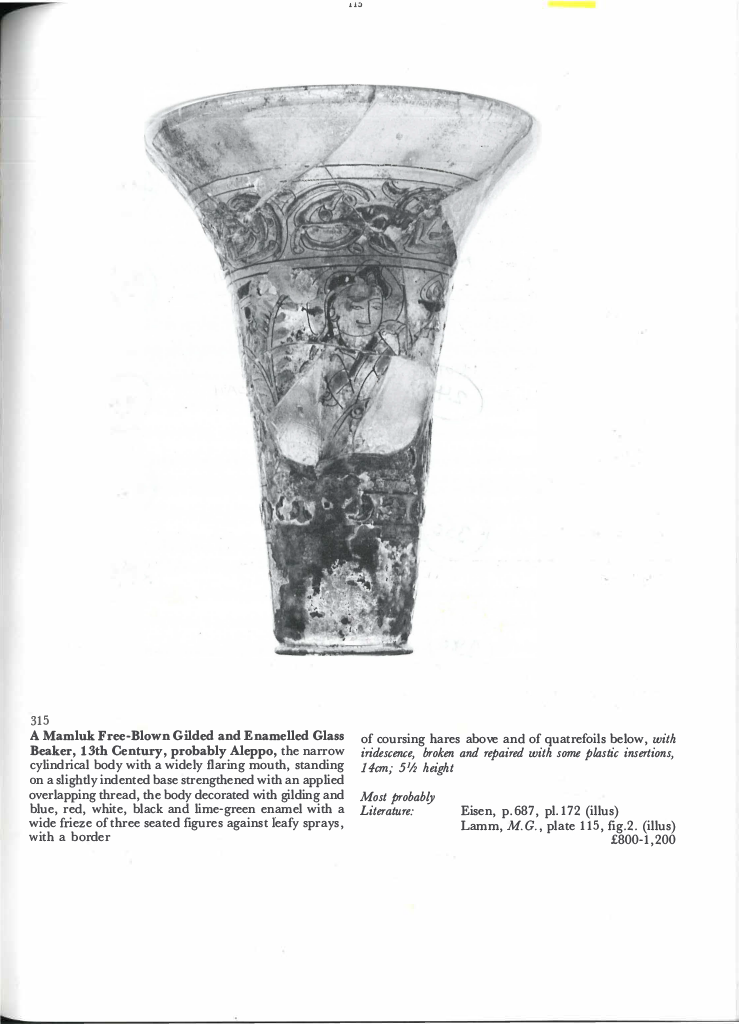
Islamic Works of Art, Carpets and Textiles, Sotheby’s, London, 14th October 1987, lot 315.
Passing from the ownership of a specialist dealer, through to a specialist collector, and now a specialist museum, this beaker represents a remarkable example of thirteenth-century Mamluk enamelled glass that has survived the centuries with only partial restorations.
The beaker can now be viewed in the Ancient Gallery of the Corning Museum of Glass, 2024.1.2.



 Where to find us?
 Newsletter
 Instagram
 Linked in
 Email
Email