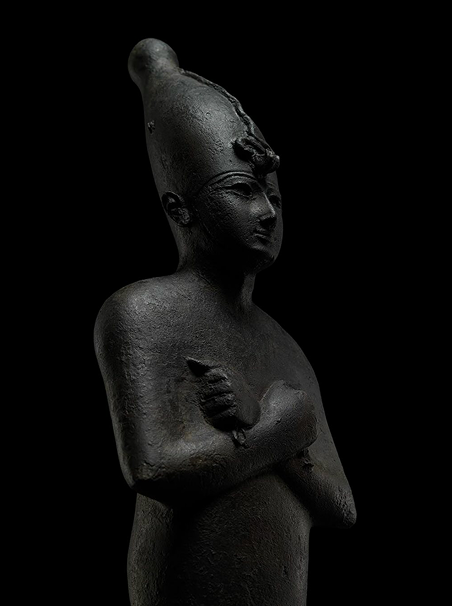
At TEFAF Maastricht 2026 David Aaron will exhibit ancient artworks with exceptional provenance and condition spanning Roman, Greek, Egyptian, and Near Eastern cultures. TEFAF Maastricht is widely regarded as the world’s premier fair for fine art, antiques, and design, bringing together over 260 prestigious international dealers and attracting esteemed museums and collectors from around the world.
David Aaron will present an exhibition of exquisite pieces with highlights including a rare Greek stele of a Parthenos circa 375-350 B.C.; an Egyptian Limestone Baboon from 664-343 B.C., and a Roman Torso of a Youth from the 1st-2nd century A.D. from esteemed Italian collector Stefano Bardini’s collection.
The Greek stele is a remarkably rare marble tombstone titled 'Stele of Medeia', one of very few surviving examples dedicated to a Parthenos - a young Athenian woman of marriageable age who has not yet wed. Inscription on the architrave of the stele identifies the young woman as Medeia. What makes this work extraordinary is its rarity; the term Parthenoi refers to the brief transitional period for a girl between childhood and entry into adulthood through marriage making depictions on Greek stelae scarce. Adding to this stele’s importance is its distinguished provenance. The stele was previously owned by renowned gallerist Joseph Brummer and remained with the Brummer family in their revered collection for more than half a century. Led by three Hungarian brothers - Joseph, Imre, and Ernest - the Brummer gallery business was established in 1910 and operated in Paris and New York across the 20th century.
Another highlight piece, the 'Roman Torso of a Youth' from the 1st-2nd century A.D., arrives in Maastricht with newly discovered provenance. Research by David Aaron uncovered new provenance for the Torso dating back to 1898, through historic images in gallerist Stefano Bardini’s innovative photographic archive. Art dealer and restorer Stefano Bardini was famed for amassing an impressive collection of artworks dating from the Roman age to Baroque. What set Bardini apart from other antiquarians was his early adoption of photography, which he used to document his expansive collection, and as a tool to advertise his business to great success. Bardini worked with photographers locally and abroad to capture detailed photographs of each piece in his collection, forming an extensive archive, which enabled David Aaron to uncover images of the sculpture dated to 1898 – providing definitive evidence that the piece was with Bardini by this date.
Finally, David Aaron will present an Egyptian Limestone Baboon from 664-343 B.C., 26th-30th Dynasty, Late Period. Baboons were highly regarded in ancient Egypt as an embodiment of Thoth, god of the moon and also as an adviser to Ra the sun god. T
TEFAF Maastricht 2026
Preview 12 March 2026
14 - 19 March 2026
At TEFAF Maastricht 2026 David Aaron will exhibit ancient artworks with exceptional provenance and condition spanning Roman, Greek, Egyptian, and Near Eastern cultures. TEFAF Maastricht is widely regarded as the world’s premier fair for fine art, antiques, and design, bringing together over 260 prestigious international dealers and attracting esteemed museums and collectors from around the world.
David Aaron will present an exhibition of exquisite pieces with highlights including a rare Greek stele of a Parthenos circa 375-350 B.C.; an Egyptian Limestone Baboon from 664-343 B.C., and a Roman Torso of a Youth from the 1st-2nd century A.D. from esteemed Italian collector Stefano Bardini’s collection.
The Greek stele is a remarkably rare marble tombstone titled 'Stele of Medeia', one of very few surviving examples dedicated to a Parthenos - a young Athenian woman of marriageable age who has not yet wed. Inscription on the architrave of the stele identifies the young woman as Medeia. What makes this work extraordinary is its rarity; the term Parthenoi refers to the brief transitional period for a girl between childhood and entry into adulthood through marriage making depictions on Greek stelae scarce. Adding to this stele’s importance is its distinguished provenance. The stele was previously owned by renowned gallerist Joseph Brummer and remained with the Brummer family in their revered collection for more than half a century. Led by three Hungarian brothers - Joseph, Imre, and Ernest - the Brummer gallery business was established in 1910 and operated in Paris and New York across the 20th century.
Another highlight piece, the 'Roman Torso of a Youth' from the 1st-2nd century A.D., arrives in Maastricht with newly discovered provenance. Research by David Aaron uncovered new provenance for the Torso dating back to 1898, through historic images in gallerist Stefano Bardini’s innovative photographic archive. Art dealer and restorer Stefano Bardini was famed for amassing an impressive collection of artworks dating from the Roman age to Baroque. What set Bardini apart from other antiquarians was his early adoption of photography, which he used to document his expansive collection, and as a tool to advertise his business to great success. Bardini worked with photographers locally and abroad to capture detailed photographs of each piece in his collection, forming an extensive archive, which enabled David Aaron to uncover images of the sculpture dated to 1898 – providing definitive evidence that the piece was with Bardini by this date.
Finally, David Aaron will present an Egyptian Limestone Baboon from 664-343 B.C., 26th-30th Dynasty, Late Period. Baboons were highly regarded in ancient Egypt as an embodiment of Thoth, god of the moon and also as an adviser to Ra the sun god. T
Selected Artworks

Belt Plaque
1st-2nd Century A.D., Scythian
Bronze
L: 9.5 cm, H: 8.9 cm
£45,000

Polytheistic Figure
664-343 B.C., 26th-30th Dynasty, Late Period, Egypt
Bronze
H: 22.9 cm
Sold

Stele of Thutmose IV
C. 1417-1407 B.C., Reign of Thutmose IV, 18th Dynasty, New Kingdom, Egypt
Limestone
H: 69 cm, L: 46 cm
Sold

Head of Hermes
1st-2nd Century A.D., Roman
Marble
H: 25 cm
Sold

Gold Bracelet
Gold
Dorset
C. 1400-1100 B.C.
£80,000

Head of Hadrian
Italy
120-130 A.D., Roman
Marble
H:36cm W:25cm D:25cm
Sold

Roman Torso of a Youth
Roman
1st-2nd century A.D.,
Marble
H: 82 cm
Sold

Stele for Medeia
Circa 375-350 B.C., Attic Greek
Marble
H: 65.5 cm, W: 57.0 cm, D: 10.0 cm
Sold
Photos




 Where to find us?
 Newsletter
 Instagram
 Linked in
 Email
Email