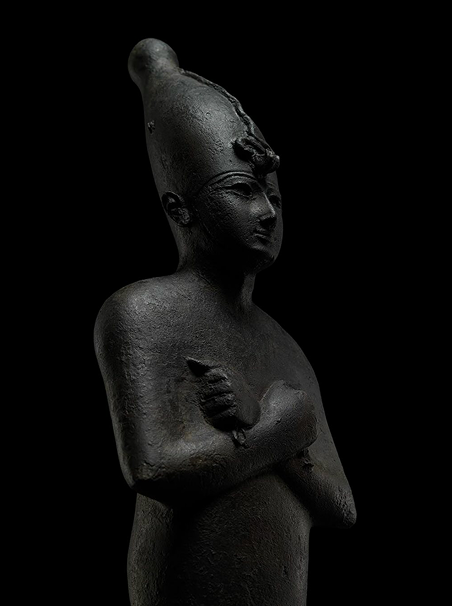
Camarasaurus supremus Skull with Embedded Allosaurus Tooth


Camarasaurus supremus Skull with Embedded Allosaurus Tooth
145-155 Million Years
57 x 31 x 58 cm (22 ¹/₂ x 12 ¹/₄ x 22 ⁷/₈ inches)
Fossilised Bone
USA
PoR
 Enquire
The distinctive skull of a subadult Camarasaurus supremus, complete with full dentition. This is a remarkably complete example – sauropod skulls are notoriously fragile, as their thin cranial bones tend not to survive the fossilisation process. Even more notably, buried in the lower left jaw is a tooth from an Allosaurus. For the tooth to become embedded in the skull, the Camarasaurus must have been the brunt of the apex predator’s forceful bite.
Camarasaurus is a genus of sauropod dinosaur which thrived during the Late Jurassic Period in North America as the most common dinosaur in the Morrison Formation. A tall sauropod with the typical long neck and tail, proportionally small head, and broad legs, Camarasaurus could reach heights of up to 5 metres for feeding. Four species of Camarasaurus are known today: C. supremus, C. grandis, C. lentus, and C. lewisi. C. lentus, C. grandis, and C. lewisi were around the same size, and could grow up to approximately 15 metres long. Camarasaurus supremus bones are about 50% larger than these species, suggesting it could have reached almost 23 metres long and weighed around 42.3 tonnes if its bodily proportions accord with the better-known species. In 2024, Gregory S Paul estimated that C. supremus would have been about 18 metres long, with a weight of 24 tonnes. Compared with other sauropods, the Camarasaurus’ ribs are proportionally wider, lending it a greater bulk, while the neck and tail were comparatively short and the skull larger. Camarasaurus’ skull was larger than those of other sauropods. Its massive upper and lower jaws would have allowed for higher bite forces. The upper jaw held 13-14 teeth on each side, with another 13 on either side of the lower jaw. Each tooth was spoon-shaped, tilted forwards, and quickly regrown if lost. The enlarged external naris (nostril) created an arched forehead, like in the contemporary Brachiosaurus. By contrast, the Camarasaurus had a shorter, rounder snout, which tapered slightly. When viewed from the back, the skull appears almost rectangular.
Camarasaurus was first discovered in early 1877, during the Bone Wars of the late 19th Century. Palaeontologist Edward Drinker Cope paid a local teacher to excavate some fossils found at Garden Park, Colorado after they were originally unearthed by a fossil collector working for Cope’s rival Othniel Charles Marsh, who was not interested in these specimens. Cope described the species based on eight vertebrae which were sent to him, naming the dinosaur ‘Camarasaurus’ (chamber lizard) after the chambers in the cervical and dorsal vertebrae. This example was of the supremus type, named for its large scale; it was described by Cope as ‘the largest or most bulky animal capable of progression on land, of which we have any account’. By 1884, Cope had received the rest of the fossils from the site, comprising the majority of the skeleton.
Found and legally excavated from private property of James and Lace Honert, Jurassic Corporation, Moffat County, Colorado, USA, GPS coordinates 40º16’14’’N 108º43’12”W, elevation 1,801.43 m, September-October 2022.
With Utah Dump Digger, American Fork, Utah, USA, acquired from the above on 10 April 2023.
With Your Museum, Bouc bel air, France, acquired from the above on 26 March 2024.
With Wunderkammer Zurich GmbH, Zurich, acquired from the above on 10 March 2025.
With Maxprime GmbH, Zurich, acquired from the above on 22 February 2026.
ALR: S00275983, with IADAA Certificate, this item has been checked against the Interpol database

 Established 1910




 Where to find us?
 Newsletter
 Instagram
 Linked in
 Email
Email