Sculptor’s Model of a Royal or Divine Head


Sculptor’s Model of a Royal or Divine Head
175 x 14.4 x 5.5 cm (68 ⁷/₈ x 5 ⁵/₈ x 2 ¹/₈ inches)
Granite
Egypt
PoR
 Enquire
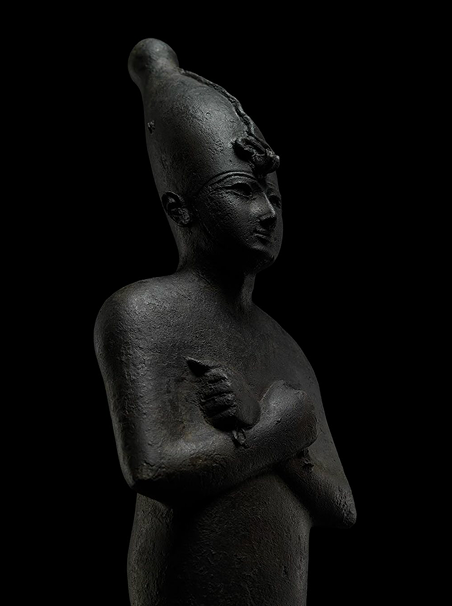
A finely carved head in profile in low relief, facing right. The figure is shown wearing a tripartite wig, identifying them as either a royal or a deity. The facial features are delineated clearly: a straight, gently sloping nose; wide almost-squared lips, upturned into a smile; and an almond-shaped eye framed by bold cosmetic lines that extend right up to the edge of the wig. The figure’s clothing from the neck downwards and the area to the rear of the wig are left largely uncarved and only outlined in silhouette. The relief is carved from the granite known as ‘fine granite’ mined from Aswan at the First Nile Cataract in Egypt. The light-grey to pinkish-grey stone was used only rarely during the New Kingdom and the Ptolemaic Period.
Many small sculptures and reliefs from ancient Egypt seem to have been left deliberately incomplete, and several together appear to demonstrate the successive stages of the carving process. Pieces such as this are thought to be sculptor’s models, created to demonstrate the technique required to create finished works. Another theory is that works such as this were created as votive gifts, to be dedicated in temples, which is supported by the inscriptions and find sites of some of these works. However, due to an almost total lack of painted examples (compared to the colourful paintwork of completed limestone sculptures), and the fragmentary nature of some of the works, it seems that this was not their primary function. It may have been that the models were dedicated later in their lifespans, perhaps to the creator’s patron deity.
Master Sculpture from Four Millennia, Sotheby's, Paris, 13 November 2025
Lot 3. David Aaron, IX, 2026, no. 7, pp. 21-26.
Previously in the Private Collection of Emile Miriel (1876-1940), France, by at least 1922, with custom-made slanted yellow marble stand from the early 20th Century.
Private Collection of Françoise Schlumberger-Primat (1917-1998), Château de Grandchamp-le-Château, Calvados, France, acquired in the 1960s or earlier.
Thence by descent to her daughter, Margaux Primat (b. 1988), Santa Monica, U.S.A., the relief remained in France from 1998-2025, accompanied by French passport 258745. Sold at: Master Sculpture from Four Millennia, Sotheby's, Paris, 13 November 2025, Lot 3.
With David Aaron Ltd., London, acquired from above sale. ALR: S00271543, with IADAA Certificate, this item has been checked against the Interpol database.
Emile Miriel (1876-1940) was born in Brest on 12 November 1876. He served as an Inspecteur des Finances as well as various other positions within the Crédit Foncier Egyptien (including as Chief of Staff to Minister Merlou, Director of Personnel, and Director of Debt). He worked for the CFE for over two decades, and gained great authority as an advisor on how to best protect French interests in Egypt. During his many visits to Egypt for his work, he collected a range of antiquities that he brought back home to France. Miriel was one of the founders of La Societé des Amis de l’Art in 1924, alongside other prominent collectors. He donated works to various museums during his lifetime, including many to the Musée du Louvre in Paris.
In 1922, Miriel was one of the key collectors who lent works to the Louvre’s exhibit to celebrate the centenary of Champollion translating hieroglyphs using the Rosetta stone. Works from his collection were exhibited alongside works lent by Baron Edmond de Rothschild, Joanny Benoitjoa Peytel, Colonel Mutiaux, Marcel Guérin, and Calouste Gulbenkian, as well as works from the Louvre’s own collection that were not on permanent display. The ancient Egyptian artworks, including this relief, were organised in the Colonnade room, arranged around a portrait of Champollion by Georges Bénédite.

 Established 1910


 Where to find us?
 Newsletter
 Instagram
 Linked in
 Email