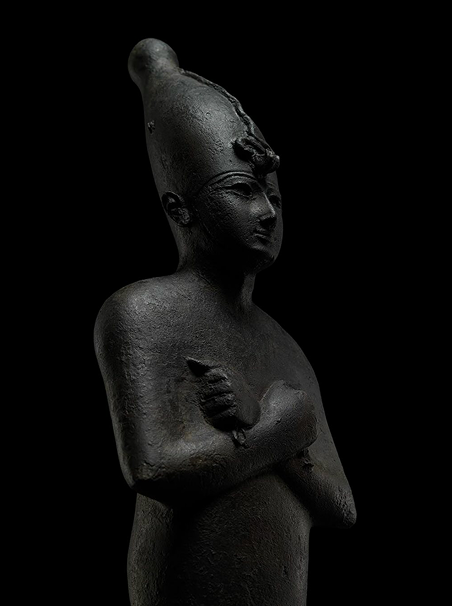
Large Cycladic Head


Large Cycladic Head
H: 15.2 cm, W: 7.5 cm
Marble
Cyclades
Circa 2600-2400 B.C., Early Bronze Age II
Sold
 Enquire
A simplified marble head from a Cycladic idol. The head is on an impressively grand scale, making the full estimated length of the figure 70 cm tall – much larger than most idols of this type.1 The head is typically abstracted, with a slightly rounded chin and broader, flatter top, the smooth surface broken only by the long triangular nose in raised relief. The neck is set back from the chin and meets the rear of the head at an angle, forming a curved profile.
Much of the evidence we have for the Early Cycladic period comes from goods and objects that were found in tombs on the Greek islands of the Cyclades. The tombs contained a range of objects in different materials: tools and weapons of Melian obsidian and bronze; shell, stone, bone, bronze and silver jewellery; and elaborately carved soapstone boxes. However, marble was clearly the preferred material for sculpting. The marble came mainly from the islands of Naxos and Keros, and some from Paros and Ios. Marble objects were made only during the first two phases of Early Cycladic culture, with the folded-arm figures appearing only in the second stage.
The meaning and use of such figures remains uncertain, and may have changed across the five centuries in which they were produced. Some archaeologists have suggested that they were produced solely for funerary use, and may have fulfilled the same role as ushabtis in Egyptian graves (to perform work for the owner in the afterlife), as substitutes for human sacrifice, or as guides for the soul of the deceased. Others have suggested that they had apotropaic qualities. Another theory is that they represent figures from Cycladic mythology, and could even have been images of the ‘Great Mother’ goddess. There is little evidence for this deity in Cycladic culture, however, and androgynous figures such as this, as well as examples with male genitalia have also been excavated. Some figures were found broken and repaired prior to their placement in the tomb – this suggests that they were used before they were interred, perhaps within a domestic shrine.
Pat Getz-Preziosi, ‘Cycladic Objects in the Fogg and Farland Collections’, American Journal of Archaeology, 70:2 (April 1966), no. 8, p. 110, pl. 31.
Previously in the Private Collection of Leo (1922-1979) and Evelyn D. Farland (1930-2025), New York, by at least 1966.
Thence by descent.
ALR: S00266743, with IADAA Certificate, this item has been checked against the Interpol database.
Evelyn D. Farland (1930-2025), née Davidoff, was born in Paris on 25 December 1930, to Renée Martell Benassit of the Martell cognac family, and notable art collector Salomon Michel Davidoff. Both the family apartment on the fashionable Avenue Hoche and their country house in Le Vésinet were filled with their valuable collection of art and antiques, but much of it was claimed by the Nazis when the Davidoffs emigrated to the United States in 1940. Evelyn attended the private boarding school Rogers Hall School in Lowell, Massachusetts, and went on to marry Henry Moobery, the brother of her school roommate. The couple settled in New Haven, Connecticut, and had a daughter together. Following their divorce, Evelyn returned with her daughter to New York, and took residence on East 79th Street on the Upper East Side. Evelyn met Leo Farland (1922-1979) at an art opening at the MoMA, discovering that he also happened to live across the street from her. Farland worked as an investment banker for Louis Dreyfus, and had met many contemporary artists during his time living in Paris; Man Ray, for instance, became a lifelong friend of the family and often stayed in Farland’s apartment when visiting New York. After they married, the Farlands moved in together in Leo’s apartment and purchased a country house in Water Mill, Long Island. They travelled frequently, and often returned to their beloved Paris.
Both Farlands had their own passion for collecting and, when combining their works, Evelyn realised that there was no established art historical tradition for American posters (unlike in her native Paris). Together, she and Leo established Poster Originals, Ltd., which set out to redefine the role of the art poster in the U.S.A.. Their business thrived, opening galleries in SoHo and the upper east side, as well as on Madison Avenue, and Main Street in East Hampton. Poster Originals’ catalogue grew to include 1,500 American and European artworks, featuring pieces by many of the artists featured in Evelyn’s poster collection – Alexander Calder, Sonia Delaunay, Jim Dine, David Hockney, Jasper Johns, Alex Katz, Roy Lichtenstein, Man Ray, Andy Warhol, and Tom Wesselman were among those represented. Poster Originals frequently collaborated with well-known museums and cultural institutions, such as the MoMA, the Metropolitan Museum of Art, the Guggenheim Museum, the Whitney Museum in New York, the Smithsonian, the National Gallery of Art, the Hirshhorn in D.C., LACMA, the Art Institute of Chicago, and the Musée du Louvre. So too, did they work with cultural institutions such as the Lincoln Center and the American Ballet Theatre, and completed commissions for the Olympic Games in Munich (1972) and Los Angeles (1984).
Evelyn continued to grow her personal collection, often buying works from artists she knew socially. The Farlands’ apartment on 79th Street was home to their acquisitions, where they were displayed for the guests of their regular evening entertainments. They were often visited by gallerists, artists, and other famous figures. Following Leo’s death in 1979, Evelyn continued collecting into the 1990s. Another Cycladic idol which was previously in the Farland collection can now be found in the Getty’s collection (88.AA.77).

 Established 1910




 Where to find us?
 Newsletter
 Instagram
 Linked in
 Email
Email