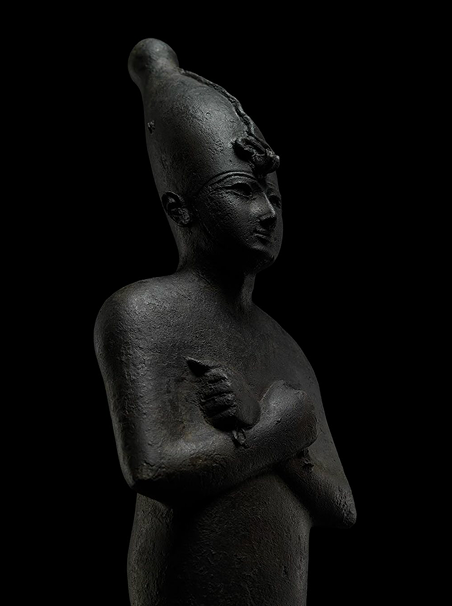
Statue of Chalchiuhtlicue


Statue of Chalchiuhtlicue
61 x 0 cm (24 x 0 inches)
Stone
Mexico
Circa 1400-1521 A.D., Post-Classic Period, Aztec (or Mexica) Culture
£135,000
 Enquire
Standing figure of the Mexican goddess Chalchiuhtlicue carved from grey volcanic stone with a reddish-brown patina. The goddess stands frontally with her feet shoulder width apart. Her true left arm, now damaged, would have been raised at ninety degrees to the chest. She wears a skirt and a poncho with triangular panels that fall over her chest and back. She also sports her distinctive headdress of several wide bands of fabric, adorned with two large tassels framing her face on either side and lined with round amaranth seeds. Two long strands hang down the goddess’s back. A multistrand pearl necklace drapes elegantly over the front of the poncho. A cavity in the solar plexus would originally have held a valuable stone inlay. Her facial features are rendered simply but clearly – the eyes and mouth are recessed ovoid forms, with the triangular nose in raised relief between them.
Chalchiuhtlicue, or ‘She of the Jade Skirt’, is an Aztec goddess of water – encompassing rivers, seas, and rainstorms – as well as of fertility, serving as patroness of childbirth. She was a major goddess for the Nahuas in the Postclassical period of central Mexico. Closely associated with water god Chalchiuhtlatonal, wife and/or sister of the rain god Tlaloc, mother of moon god Tecciztecatl, or wife of senior deity Xiuhtecuhtli (depending on the text), Chalchiuhtlicue was a central figure in the Aztec pantheon. The goddess was believed to help Tlaloc to rule the paradisial kingdom of Tlalocan, bring fertility to crops, and protect women and children. She held a dual role as life-giver and life-ender. Once, in retaliation against her mistreatment by Tlaloc, Chalchiuhtlicue is said to have released 52 years of rain, causing a flood that extinguished the Fourth Sun and prompted the development of our current world (the Fifth Sun). She also built a bridge between heaven and earth, allowing those in her favour to travel between the two in the form of fish.
America Antiqua: Vergeten Indiaanse Grootheid, Rotary Club Sint-Niklaas, Sint-Niklaas City Council, Vlaams Institut voor Amerikanistiek, Stedelijk Museum van Sint-Niklaas, Sint-Niklaas, Belgium, 2-30 November 1975, no. 21.
Art de Mésoamérique, Meso-Amerikaanse Kunst, Société Générale de Banque, Brussels, 17 November 1976-8 January 1977, no. 104.
America Antiqua: Vergeten Indiaanse Grootheid, Rotary Club Sint-Niklaas, Sint-Niklaas City Council, Vlaams Institut voor Amerikanistiek, Stedelijk Museum van Sint-Niklaas, Sint-Niklaas, Belgium, 2-30 November 1975, pp. 17, 45, 58, no. 21.
Art de Mésoamérique, Meso-Amerikaanse Kunst, Société Générale de Banque, Brussels, 17 November 1976-8 January 1977, no. 104.
Previously in the Private Collection of Ferdinand Seiffart (1802-1877), Mexico (1845-1850), Berlin (1850-1856), and Nordhausen (1856-1877), by at least 1852.
Museum für Volkerkunde, Berlin, bequeathed by the above in 1852, until 1972, acquisition number IV Ca 173/ No. 3004, accompanied by 1852 correspondence between Seiffart and the museum, original entry in the museum catalogue (no. 3004).
With Galerie Deletaille, Brussels, December 1971, acquired from the above, accompanied by 1972 certificate of authenticity from the museum.
Private Collection, Belgium, acquired from the above in 1972, accompanied by an insurance document dated 20 March 1986.
ALR: S00273527, with IADAA Certificate, this item has been checked against the Interpol database.
Ferdinand Seiffart (1802-1877) was born into an old Nordhäuser Patrizier family, the son of lawyer and city mayor, Karl Wilhelm Ferdinand Seiffart and Johanna Maria Seiffart. He enrolled at the University of Göttingen to study law, and went on to work in the Prussian Ministry of Trade and Commerce after passing his exam. He married Ida Riemann on 13 October 1830. He then served as a judicial officer in the Berlin Police Headquarters before being appointed Secret Government Councillor in the Ministry of the Interior and personal advisor to the Minister Gustav von Rochow. In 1837, Seiffart was sent to the German-Russian border to combat smuggling, and was awarded the Russian Saint-Stanislaus Order 2 for his achievements there.
In 1845, he was appointed as the Royal Prussian Consul General in Mexico. During the five years he held this position, Seiffart played a key role in convincing the Mexican government to accept the treaty of Guadalupe Hidalgo, ending the Mexican-American war and preventing their annexation by America. Seiffart mediated in several other conflicts and was much lauded for his work there. In this period, Seiffart acquired a wide collection of Mexican antiquities, many of which he bequeathed to the Museum für Volkerkunde, Berlin (now the Ethnologischen Museum). The bulk of the museum’s holdings of artefacts from the ancient city of Teotihuacan were donated by Seiffart.
In 1850, Seiffart returned to Berlin to work for the Prussian Chamber of Auditors. He was promoted to Vice-President of the Chamber by the King in 1854, and retired in 1856. Following his retirement, he returned to Nordhausen, where he served as a city councillor until his death in 1877.

 Established 1910


 Where to find us?
 Newsletter
 Instagram
 Linked in
 Email