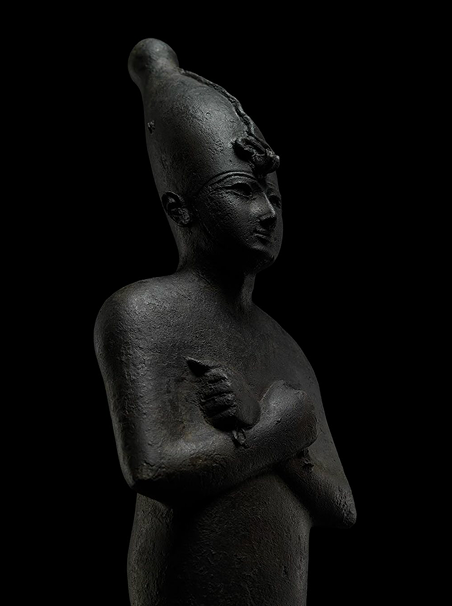
Amulet of Ptah-Patek


Amulet of Ptah-Patek
H: 7.7 cm
Faience
Egypt
664-525 BC, probably 26th Dynasty, Late Period
£75,000
 Enquire
A blue faience amulet depicting the god Ptah-Patek. Ptah-Patek is represented as a nude bow-legged dwarf with a pronounced pot belly and an overly large, bald head. The god stands with both feet placed on the heads of crocodiles, and holds a serpent in each hand, represented through incised lines on the torso. A falcon stands on each of his shoulders, facing frontally. On his head is a large scarab beetle. On the god’s proper right side stands the goddess Nepthys, shown nude and wearing a solar disc and long horns, while on the left side is the goddess Isis wearing a naos headdress. The reverse of the figure is a flat back panel, incised with an image of the goddess truth and justice, Maat, her winged arms outstretched on either side of her body. She, too, wears the solar disc and horns, and a large ostrich feather (Maat’s name in hieroglyphs) is reflected on both sides of her head.
Ptah-Patek, also known as Pataikos, was a protective deity in ancient Egypt. The name ‘Pataikos’ was coined by Herootus, who refers to the apotropaic dwarf figureheads on Phoenician ships as such in his Histories (c. 440 BC). According to the Greek historian, Ptah-Patek was a son or manifestation of the god Ptah – ‘Pataikos’ means ‘little Ptah’. Ancient Egyptians believed that dwarves were experts in metallurgy and were thus associated with Ptah as the patron god of craftsmen. The cult of Ptah-Patek became popular in the Late Period, and spread throughout the Eastern Mediterranean during the Hellenistic Period. From the 22nd Dynasty, Ptah-Patek was associated with Bes, another protective dwarf-god, as another assistant of hippopotamus-headed Taweret during childbirth and a protector of women and children. He was also linked with Harpocrates and Horus, and shown holding serpents or knives, with falcons on his shoulders, and standing on crocodiles. Ptah-Patek was frequently represented in the form of small faience amulets which were used to protect the wearer from evil forces, dangerous animals, chaos, and could be placed on the forehead of a pregnant woman during birth.
Osiris, Kreuz, Halbmond: 5000 Jahre Kunst in Ägypten, Kunstgebäude am Schloßplatz, Stuttgart, 18 February-23 April 1984, Kestner-Museum, Hannover, 10 May-5 August 1984, no. 59.
Antike Kunstwerk, Ars Antiqua AG, Lucerne, 2 May 1959, Lot 22, p. 9, pl. 9.
Philipp von Zabern, Osiris, Kreuz, Halbmond: Die drei Religionen Ägyptens, Kunstgebäude am Schloßplatz, Stuttgart, 18 February-23 April 1984, Kestner-Museum, Hannover, 10 May-5 August 1984, no. 59, pp. 71, 73.
Ingrid Gamer-Wallert, Vermerk: Fundort unbekannt (Tübingen, 1997), no. 387, pp. 245-246, 316, pl. 86.
Sold at: Antike Kunstwerk, Ars Antiqua AG, Lucerne, 2 May 1959, Lot 22.
Private Collection of Erwin Oppenländer (1901-1988), Waiblingen, Germany, acquired from the above sale, accompanied by handwritten inventory card, no. 1213-5383.
Thence by descent.
ALR: S00274860, with IADAA Certificate, this item has been checked against the Interpol database.
Erwin Oppenländer (1901-1988) was born in Waiblingen near Stuttgart in 1901, where he continued to live and work as a manufacturer until his death in 1988. He was a discerning collector, gathering a wide range of high-quality antiquities from auction houses and art dealers, from 1930 onwards. Oppenländer had contacts throughout the art world, with some of his earliest acquisitions coming directly from the collection of archaeologist and art dealer Pierre Mavrogordato in Berlin. He was highly selective, with a refined aesthetic sense, and grew his collection without acquiring any duplicate objects. He collected works from ancient Mesopotamia, Egypt, Greece, and the Roman Empire. His glass collection, which stretched from the invention of glass in about 2500 BC to 11th Century AD Byzantine and Islamic glassware, was particularly famous. Much of it was exhibited at the Museum für Kunst und Gewerbe, Hamburg and the Römisch-Germanisches Museum in Cologne in 1974, and in 2003, 350 items were purchased by the J Paul Getty Museum, Los Angeles. A group of 161 ancient Mesopotamian cylinder seals from Oppenländer’s collection were acquired by the Freie Universität Berlin in 1967 for use as a teaching collection. By contrast, his Egyptian collection is relatively unknown to the public, although select items appeared in 20th-century exhibitions in Munich, Stuttgart, and Hanover.

 Established 1910


 Where to find us?
 Newsletter
 Instagram
 Linked in
 Email