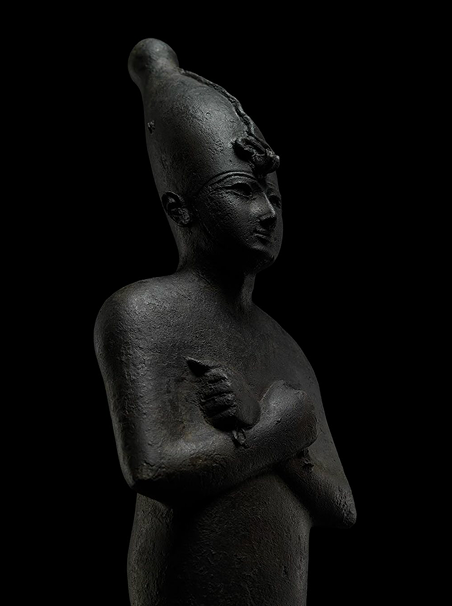
Ushabti for Nefer-ib-Re-sa-Neith


Ushabti for Nefer-ib-Re-sa-Neith
H: 16.8 cm
Faience
Egypt
Circa 570-526 BC, Reign of Amasis, 26th Dynasty, Late Period
£38,500
 Enquire
A turquoise faience ushabti in typical mummiform pose. The arms are crossed over the chest, holding an adze in the proper left hand and a hoe in the right. A sack of grain hangs over the left shoulder, on the figure’s back. The ushabti wears a tripartite, wig, falling forwards over the shoulder and down the back, and a false beard. The body is incised with ten remaining lines of hieroglyphic inscription (the lowest one partial), which records the name of the deceased ‘Nefer-ib-Re-sa-Neith’ and extracts from Chapter Six of the Book of the Dead.
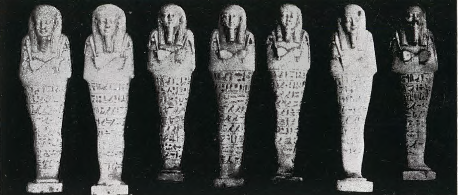
Image: Selection of ushabtis from the tomb of Nefer-ib-re-sa-Neith, Drioton and Lauer, ‘Fouilles à Saqqarah’, pl. VIII 1.
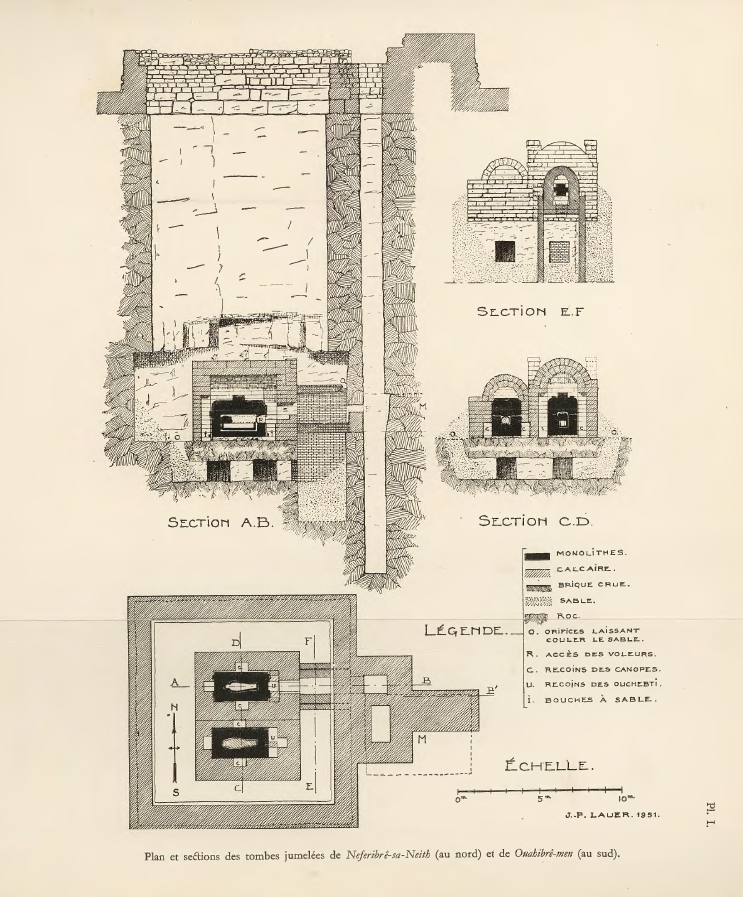
Image: Plan and sections of the tomb of Nefer-ib-re-sa-Neith. Ét. Drioton and J-P Lauer, ‘Fouilles à Saqqarah: Les Tombes Jumelées de Neferibrê-sa-Neith et de Ouahibrê-Men’, Annales du Service des Antiquités de l’Égypte, 51 (1951), pl. I.
Nefer-ib-re-sa-Neith’s name translates as ‘Psammetichus II is the son of Neith’, which indicates that Nefer-ib-re-sa-Neith was born during the rein of Psammetichus II (r. 595-589 BC). Nefer-ib-re-sa-Neith was the son of woman named Shepenbastet, and his tomb was discovered in 1929 by British Egyptologist Cecil Mallaby Firth during excavations south of the pyramid of Userkaf at Saqqara. Nefer-ib-re-sa-Neith’s tomb was found in the northern vault of a pair of vaulted shaft tombs. Although the tomb had been looted in antiquity, and the mummy removed from the stone coffin, atop the broken lid of the outer sarcophagus were a group of faience ushabtis (most likely originally placed in a box, since burned). Other ushabtis were found in a sand-filled shaft at the western end of the tomb. Firth recorded that 336 ushabtis were found within the tomb, which have since been internationally dispersed through the Service des Antiquités de l’Égypte. Nowadays ushabtis of Nefer-ib-re-sa-Neith can be found in private collections and museums around the world, including the British Museum, London (EA64347), the Ägyptisches Museum und Papyrussammlung Berlin (VÄGM 2014/137), The Indian Museum Kalkata (65/18), and the Metropolitan Museum of Art, New York (58.4.2).
Ushabtis were intended to spare their owners from manual corvée labour in the afterlife, as a stand-in for both the deceased and their servants. In the 18th Dynasty, these statues were referred to as ‘shabti’, but by the Late Period the word ‘ushabti’ came into use. ‘Ushabti’ may derive from the verb ‘wesheb’, meaning to answer, in reference to Chapter Six of the Book of the Dead (known as the Ushabti Chapter), which describes how ushabti should answer the call to work in lieu of their owners. This passage is frequently inscribed on the front of ushabti.
From the tomb of Nefer-ib-Re-sa-Neith, Saqqara.
Previously with Joachim Phillip ‘Jock’ Francken (1906-1994), Lugano, by at least 1969, accompanied by report and translation by Professor Hans Wolfgang Müller (1907-1991), Chair of Egyptology at the Ludwig-Maximilians-Universität, Munich, and director of the Staatliche Sammlung Ägyptischer Kunst, dated 9 June 1969.
Private Collection of Erwin Oppenländer (1901-1988), Waiblingen, Germany, acquired from the above on 12 June 1969, accompanied by handwritten inventory card, no. 6359.
Thence by descent.
ALR: S00274667, with IADAA Certificate, this item has been checked against the Interpol database.
Joachim Phillip ‘Jock’ Francken (1906-1994) was born in Aachen, Cologne on 7 September 1906 to merchant Alfred Francken and violinist Betty Schwabe. Francken first visited New York in 1934, and moved there in 1938 to escape the Nazi regime. His mother was killed in the Sobibor concentration camp in 1943, and Francken lost his German nationality under the 11th Ordinance of the Reichsbürgergesetz on 25 November 1941. In 1945, Francken married Czech artist Ruth Steinreich who had also moved to the USA from 1942. Francken adopted the first name ‘Jock’ when he registered as an American citizen in 1951. He moved to Switzerland in the 1950s, living first in the Villa Ly, Lugano-Suvigliana, and later in Casa Torre, Catsagnola-Cassarate, Lugano. Francken worked as an antiques dealer and inventor, and developed a wide international network of collectors and dealers, including Édouard Guigoz, Heinz Herzer, and the Resandro collection.
Erwin Oppenländer (1901-1988) was born in Waiblingen near Stuttgart in 1901, where he continued to live and work as a manufacturer until his death in 1988. He was a discerning collector, gathering a wide range of high-quality antiquities from auction houses and art dealers, from 1930 onwards. Oppenländer had contacts throughout the art world, with some of his earliest acquisitions coming directly from the collection of archaeologist and art dealer Pierre Mavrogordato in Berlin. He was highly selective, with a refined aesthetic sense, and grew his collection without acquiring any duplicate objects. He collected works from ancient Mesopotamia, Egypt, Greece, and the Roman Empire. His glass collection, which stretched from the invention of glass in about 2500 BC to 11th Century AD Byzantine and Islamic glassware, was particularly famous. Much of it was exhibited at the Museum für Kunst und Gewerbe, Hamburg and the Römisch-Germanisches Museum in Cologne in 1974, and in 2003, 350 items were purchased by the J Paul Getty Museum, Los Angeles. A group of 161 ancient Mesopotamian cylinder seals from Oppenländer’s collection were acquired by the Freie Universität Berlin in 1967 for use as a teaching collection. By contrast, his Egyptian collection is relatively unknown to the public, although select items appeared in 20th-century exhibitions in Munich, Stuttgart, and Hanover.

 Established 1910


 Where to find us?
 Newsletter
 Instagram
 Linked in
 Email