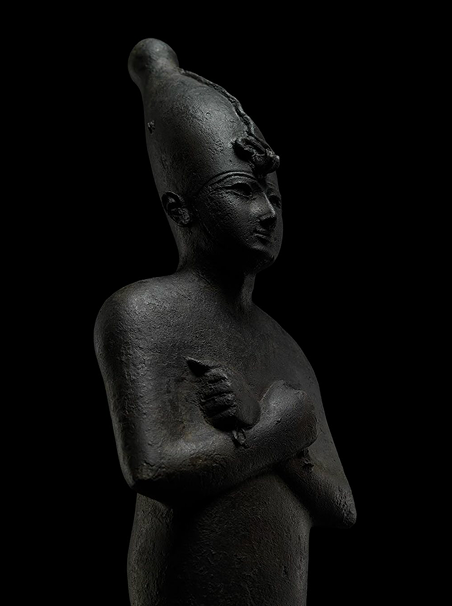
Striding Statue of Heryshaf


Striding Statue of Heryshaf
H: 10 cm
Silver
Egypt
1550-1070 BC, New Kingdom, or 900-700 BC, Late Period
£90,000
 Enquire
A standing figure of the ram-headed god Heryshaf, in traditional walking pose, with arms held straight by its sides, and the proper left foot in front of the right. The god wears a classic pleated kilt around the waist and a broad ousekh collar around the neck. The long, twisted horns extend outwards from the crown of the head, parallel with the smaller ram’s ears below. In the centre of the horns sits the atef crown, with ostrich feathers on either side, a central uraeus and a solar disc above. The god’s wig falls forwards onto the chest. The statuette stands on a rectangular base of silver. The figure demonstrates a very high quality of craftmanship, with the smallest details of texture in the kilt, wig, horns, and feathers elaborated through different patterns of incised lines. The body is softly modelled, with supple muscles in the chest and a gently curved waist. The ram’s head is beautifully rendered, projecting a friendly yet otherworldly demeanour. The figure is crafted from silver, a very rare metal in ancient Egypt, which sometimes held a higher value than even gold.
Heryshaf, also known as Hershef, Harsaphes, and Arsaphes, was an ancient Egyptian god of creation and fertility. Born from the primordial waters, his name translates to ‘he who is on his lake’, and one of his titles was ‘Ruler of the Riverbanks’. His cult was centred at Heracleopolis Magna, and, according to the Palermo Stone inscription, dates back to the Early Dynastic or Old Kingdom Period of Egypt. The earliest known temple dedicated to Heryshaf dates to the Middle Kingdom, and he rose to particular prominence during the First Intermediate Period when Heracleopolis Magna was the capital of Lower Egypt. The 12th Dynasty temple was rebuilt in the 18th Dynasty and expanded in the 19th Dynasty under Ramesses II (r. 1279-1213 BC), who added a pronaos of sixteen large palm columns. It continued to remain in use until well into the Ptolemaic Period. Heryshaf was associated with the gods Ra and Osiris, and sometimes referred to as their ba (loosely translated as ‘soul’), and occasionally linked to Atum also. His ties to Osiris are represented through the atef crown, and those with Ra through the solar disc – both of which are shown in this sculpture. The Greeks aligned him with the hero Heracles, perhaps due to translations of the Greek Harsaphes/Arsaphes as ‘manliness’, or ‘He who is over strength’.
Osiris, Kreuz, Halbmond: 5000 Jahre Kunst in Ägypten, Kunstgebäude am Schloßplatz, Stuttgart, 18 February-23 April 1984, Kestner-Museum, Hannover, 10 May-5 August 1984, no. 27.
Emma Brunner-Traut, Die Alten Ägypter: Verborgenes Leben unter Pharaonen (1974, Stuttgart, Berlin, Cologne, Mainz), pl. XVI, p. 240.
Philipp von Zabern, Osiris, Kreuz, Halbmond: Die drei Religionen Ägyptens, Kunstgebäude am Schloßplatz, Stuttgart, 18 February-23 April 1984, Kestner-Museum, Hannover, 10 May-5 August 1984, no. 27, p. 44, pl. 43.
Previously with Dr Otto Burchard (1892-1965), by at least 1964.
Private Collection of Erwin Oppenländer (1901-1988), Waiblingen, Germany, acquired from the above on 29 July 1964, accompanied by handwritten inventory card, no. 5591.
Thence by descent.
IADAA Certificate, this item has been checked against the Interpol database.
Dr Otto Burchard (1892-1965) was born on 5 May 1892. He received his highschool diploma in 1910, and went on to study at the trade school in Heidelberg. From 1911-1912, Burchard had an internship in the art trade in Shanghai, which prompted his 1913 study of sinology, ethnology and art history in Leipzig. During the First World War, he was discharged from the army in July 1916 due to injury. He opened his first gallery, dealing in historical and contemporary art, in Berlin in 1920. He then opened Dr. Otto Burchard & Co. GmbH in 1927, which grew to have offices in New York, Berlin, Beijing, and Shanghai. Burchard moved to Beijing in 1929/30, and his Berlin firm was forced to liquidate under Nazi rule in 1935. In 1946, Burchard relocated to New York, and then moved to London about five years later.
Erwin Oppenländer (1901-1988) was born in Waiblingen near Stuttgart in 1901, where he continued to live and work as a manufacturer until his death in 1988. He was a discerning collector, gathering a wide range of high-quality antiquities from auction houses and art dealers, from 1930 onwards. Oppenländer had contacts throughout the art world, with some of his earliest acquisitions coming directly from the collection of archaeologist and art dealer Pierre Mavrogordato in Berlin. He was highly selective, with a refined aesthetic sense, and grew his collection without acquiring any duplicate objects. He collected works from ancient Mesopotamia, Egypt, Greece, and the Roman Empire. His glass collection, which stretched from the invention of glass in about 2500 BC to 11th Century AD Byzantine and Islamic glassware, was particularly famous. Much of it was exhibited at the Museum für Kunst und Gewerbe, Hamburg and the Römisch-Germanisches Museum in Cologne in 1974, and in 2003, 350 items were purchased by the J Paul Getty Museum, Los Angeles. A group of 161 ancient Mesopotamian cylinder seals from Oppenländer’s collection were acquired by the Freie Universität Berlin in 1967 for use as a teaching collection. By contrast, his Egyptian collection is relatively unknown to the public, although select items appeared in 20th-century exhibitions in Munich, Stuttgart, and Hanover.

 Established 1910


 Where to find us?
 Newsletter
 Instagram
 Linked in
 Email