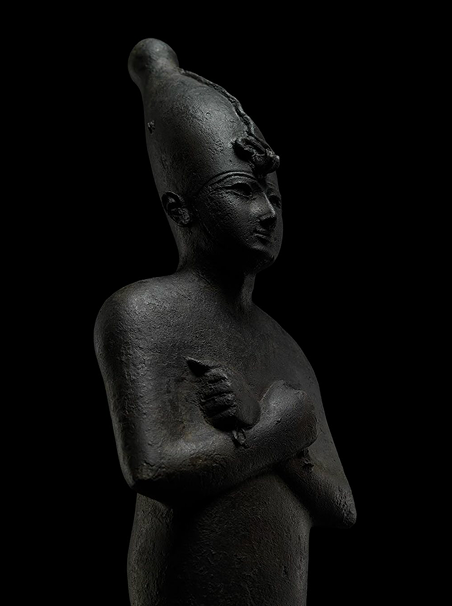
Figure of a Man


Figure of a Man
H: 31.1 cm
Wood
Egypt
2360-2195 B.C., 6th Dynasty, Old Kingdom
£100,000
 Enquire
A figure of a striding man carved from a rich, red-coloured wood. The slender figure stands with left foot in front of the right on a black rectangular base, and each of the separately carved arms held straight at his sides. Both hands are closed in fists, with thumbs extended downwards. The torso slopes into a narrow waist, and broadens upwards to the rounded shoulders. The belly button is deeply incised, while both nipples were inlaid and painted originally (only one remains intact). The partially pleated fabric of the kilt knotted below the abdomen is carved with delicate details. Each of the facial features are picked out in carved and painted lines; the broad nose and mouth are carved in relief, while the slightly recessed eyes are painted with white sclera and black outlines and pupils, and framed by long, black-painted eyebrows. The close-cropped hair is also painted a deep black.
Wooden statues and statuettes have been found in tombs spanning the entire history of ancient Egypt, even despite wood’s tendency to degrade over time. These wooden models represent a range of figures and animals, singly and in groups, often engaged in a range of activities from ‘daily life’. It is believed that these models were designed to populate the tomb with workers to ensure that the tomb owner would receive material comforts in the afterlife. Despite the skill that went into their production and the intricate details represented, the majority of these statuettes were hidden within the enclosed chambers of underground tombs, only visible to visitors through narrow viewing slits. Later examples have also been found in temple contexts, both freestanding royal statues and smaller votive figures placed in wooden shrines.
The native trees of Egypt – acacia, tamarisk, date palm, plane tree, and sycamore fig – did not provide the best wood for carving. Instead, better-quality timber had to be imported from the surrounding countries at great cost: cedar, cypress, spruce, pine, yew, and birch were imported from Syria and Lebanon, ebony from Sudan and Ethiopia. These imported woods, particularly yew and cedar, were the most expensive and, therefore, the most prestigious to work in. Wood was a good material for representing fiddly details, like limbs held away from the body, extended legs, and small hands holding smaller objects – it was soft enough to carve without huge difficulty, but strong enough to support fragile extensions. Often, as in this case, a figure’s arms were crafted separately and attached to the torso with a simple but strong mortise and tenon joint.
Wooden models were produced from as early as the Pre-Dynastic Period (for example, the gilded figures from Eastern Kom, Tell el-Farkha). The first wooden models of single figures from the Dynastic Period are dated to the end of the 5th Dynasty, and they increasingly appeared in the tombs of elite figures following the reign of Pepi II Neferkare (r. c. 2278-c. 2214 BC). From the 6th Dynasty onwards, wooden statues and statuettes supplanted limestone as the primary material used for tomb models. Many wooden tomb figures survive from the Old Kingdom, representing people engaged in a range of ‘daily life’ activities, such as farming, food preparation, brewing, animal butchering, and entertainment. Wooden model boats were also very popular.
With Dikran Khan Kelekian (1867-1951), New York, before 1951, accompanied by old photograph and inventory, no. 6473.
In the Private Collection of Richard “Max” Miller (1902-1983), Miami, Florida, acquired from the above on 11 December 1951, accompanied by dated purchase invoice.
Thence by descent.
ALR: S00269439, with IADAA Certificate, this item has been checked against the Interpol database.
Dikran Khan Kelekian (1867-1951, also known as Dikran Garabed Kélékian) was a collector and dealer of ancient, medieval, and Islamic art. Of Armenian heritage and born in Turkey, he and his brother Kevork established an antiquities business in Istanbul in circa 1892. In the following year, Kelekian travelled to the United States as a commissioner for the Persian pavilion at the World’s Columbian Exposition in Chicago. Together, he and his brother established many shops around the world. In New York, they opened shops at 709 Fifth Avenue, then at 598 Madison Avenue, and later at 20 East 57th Street; in Paris they had shops at 10, rue Rossini, and later, at 2, Place Vendôme; they also ran a shop in London and one in Cairo. Kelekian played a substantial role in the formation of the Coptic, Early Christian, and Classical collections of Henry Walters (later founder of the Walters Art Museum in Baltimore) and the Gothic collection of George Blumenthal, a financier and the president of the Metropolitan Museum of Art in New York. He was also well known as an early champion of modern French painters. Kelekian died in January 1951, when he fell from the twenty-first floor of the Hotel St. Moritz in New York.

 Established 1910


 Where to find us?
 Newsletter
 Instagram
 Linked in
 Email