The Alsdorf Bodhisattva


The Alsdorf Bodhisattva
H: 157.5 cm, W: 51 cm, H with stand: 203.5
Grey Schist
Gandhara
3rd-4th century A.D.
Sold
 Enquire
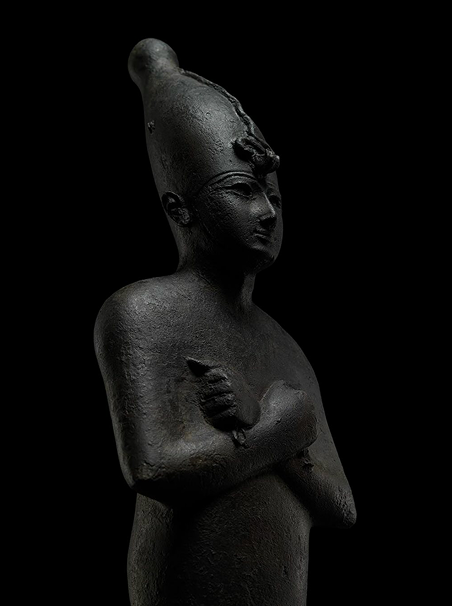
A large grey schist figure of a bodhisattva, standing on a plinth. His left hand, which rests by his side, holds a lotus flower. His right is missing from above the elbow, but was most likely raised in the Abhayamudrā, the gesture of reassurance. His head and shoulders are framed by a large disc-shaped halo, indicating his divinity. The body is solidly conceived, with a muscular torso and broad shoulders. His facial features are articulately rendered and strong, and embellished by curling moustaches.
His attire marks him as specifically Gandharan, particularly his sandalled feet (rarely encountered in other schools of Buddhist art) and necklace of charms suspended from a cord. The cord terminates in a makara, a legendary sea creature. This charm, presumably designed to protect the wearer, adds a touchingly human element to so regal a figure. He wears a dhoti and shawl and is richly adorned with jewellery, including bracelets, armlets, a heavy collar, a corded belt and hooped earrings in his long-lobed ears. He wears a jewelled headdress featuring a small stupa, and his hair falls in rich waves down his neck.
Both his headdress and the lotus flower in his hand identify him as the bodhisattva, Avalokiteshvara. Alongside the Buddha and the bodhisattva Maitreya, Avalokiteshvara is considered one of the principle deities of early Gandharan Buddhism. Avalokiteshvara translates as “Lord who looks down with compassion”.
The base of the figure bears a frieze depicting a homa, or fire ritual, performed by a monk with three participants, one of whom (far right) is female. During such rituals, the priest would pour ghee, or clarified butter, and various ointments onto the blaze lit within the cauldron. These fire rituals have their roots in the ancient Vedic religion, were adopted by ancient Buddhism and Jainism and are now found throughout the Asian subcontinent. The practice of offering symbolic objects to the gods by casting them into the fire had a votive function.
A Collecting Odyssey: Indian, Himalayan, and Southeast Asian Art from the James and Marilynn Alsdorf Collection, The Art Institute of Chicago, 2 August – 26 October 1997, cat. no. 154.
Indian and Islamic Art, Parke Bernet Galleries, New York, 3 April 1971, Lot 65.
P. Pal, A Collecting Odyssey: Indian, Himalayan, and Southeast Asian Art from the James and Marilynn Alsdorf Collection (Chicago, 1997), pp. 125, 307, cat. no. 154.
Most likely in an earlier 20th-Century Collection, based on the restoration, which was already present by the 1971 sale.
Previously in a Private Collection, New Jersey, from at least 1971.
Sold at: Indian and Islamic Art, Parke Bernet Galleries, New York, 3 April 1971, Lot 65.
Private Collection of James and Marilynn Alsdorf, Chicago, acquired from the above sale, accompanied by purchase invoice.
ALR: S00219038, with IADAA Certificate, this item has been checked against the Interpol database.
James and Marilynn Alsdorf were married in 1952 and spent their lifetime building an eclectic and famed art collection which spanned all cultures and periods.
James ‘Jim’ Alsdorf was born in Chicago, but was raised partly in China and Japan, his father having been born in Batavia (modern-day Jakarta). He married Marilynn, a Chicago girl who has studied at the School of the Art Institute, when he was thirty-five, and it was she who instilled in him a deep love of art.
Based mostly in Chicago, their collection was, as Christie’s Chairman of the Americas Marc Porter put it, “an example of cross-category collecting at its finest.” It ranged from antiquities, works on paper, European and Latin American art, and Indian and Southeast Asian art, as well as including some of the biggest names of modern and contemporary art such as René Magritte, Frida Kahlo, Joan Miró and Jean Dubuffet.
It was particularly strong in Indian, Himalayan and South East Asian art, a love in part sparked by a trip to India in 1968. Indeed, the catalogue to the exhibition of their Asian art collection at the Art Institute of Chicago in 1997 described it as “one of the most important private collections of its kind in the world.”
Because they bought so eclectically they were well-known to most major dealers, and Jim’s famously hard-lined haggling was legendary, although he was known affectionately as ‘Uncle Jim’ amongst the younger dealers. For the Alsdorfs, collecting meant visiting every dealer they had heard of and every country whose art they collected, an Odyssean task which is testament to the true pleasure they found in the experience.
As well as being great collectors, the Alsdorfs were loyal supporters of museums and cultural institutions across Chicago and the wider United States, including the National Gallery of Art in Washington, D.C., the Leigh Block Museum of Art at Northwestern University and the Art Institute of Chicago. James Alsdorf served as Chairman of the AIC from 1975 to 1978, and Marilynn sat on various committees.
In 1967, the Alsdorfs joined other prominent Chicago collectors, including, Edwin and Lindy Bergman and Robert and Beatrice Mayer, in founding the Museum of Contemporary Art Chicago, an institution to which they would provide extensive financial and personal leadership.

 Established 1910




 Where to find us?
 Newsletter
 Instagram
 Linked in
 Email
Email