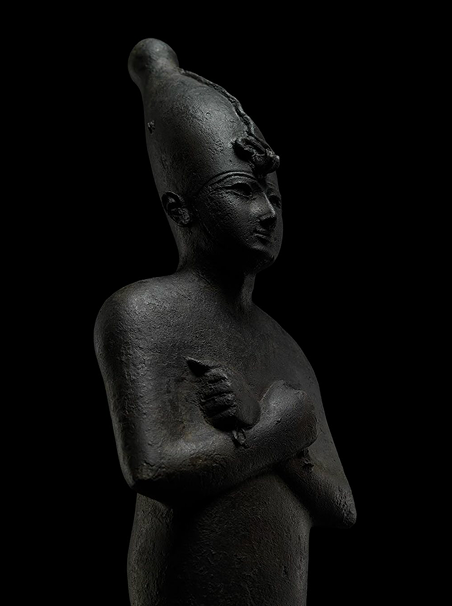
Upper Part of the Inner Coffin Lid of Horsaiset


Upper Part of the Inner Coffin Lid of Horsaiset
712-525 BC, 25th-26th Dynasty, Late Period, Egypt, probably Western Thebes
Wood, Polychromed and Stuccoed, Linen
Height: 47 cm, Width: 45 cm
£85,000
 Enquire
The upper part of the lid for a wooden inner coffin, carved into the form of a male head and upper chest. The head sports a large tripartite wig painted with gold and blue stripes that follow the line of the wig as it parts on either side of the face and ends just above the end of the false beard. The false beard itself is painted turquoise and incised with diagonal lines to represent the braid. The top portion of a patterned ousekh collar, in the same shade of turquoise, can be seen on the chest behind the beard. The skin of the head and neck is painted a deep red. The facial features modelled three-dimensionally, with a wide, slightly upturned mouth, broad nose, and narrow, slightly recessed eyes. The eyes and eyebrows are outlined in thick black lines, the heavy cosmetic lines extend a fair length from the outer corners of the eyes. The round ears sit in front of the wig on each side. On the sides of the wig, the turquoise stripes alternate with red.
The crown of the head is painted with the image of the goddess Nepthys, kneeling with her wigs outstretched, against a solid gold background. This is divided from the rest of the wig with a black border. The reverse is densely painted with eight registers of hieroglyphic inscription; the inscriptions continue over the vertical sides, and vertically below the horizontal registers (both of which are cut off at the bottom). The text includes a number of traditional offering formulas to various deities, wishes concerning the owner’s afterlife, and the formula of goddess Nut. The owner is identified as Horsaiset, son of Irtyrou, Prophet of Thoth, master of strength, Prophet of Khnum, lord of the great battle, and Prophet of Sobek, lord of the land of the trees. Painted in the centre of the reverse, below the text, is the face of the goddess Nut, facing to the right with arms raised.
The earliest symbolic role of the ancient Egyptian coffin was as a ‘house’ or eternal dwelling for the deceased. Outer coffins tended to be rectangular, imitating the shape of a tomb or shrine, while inner coffins were mostly anthropoid in form from the Middle Kingdom onwards. From the New Kingdom, coffins showed an increased resemblance to the living, in both form and dress, demonstrating the link between coffins as separate to, but one aspect of, the self. Wood was used as a material for coffins since very early in ancient Egyptian history. Cedar was the most prestigious wood, as it provided long, straight planks. However, it had to be imported into Egypt from the Lebanon, making it highly expensive and, therefore, a sign of high status. Coffins made from local woods, generally sycamore fig, had to collate smaller, irregularly shaped pieces using wooden cramps and dowles, which had to be secured at the corners with leather thongs.
Previously in the Private Collection of Admiral Joseph Maurice Exelmans (1816-1875), 2nd Comte Exelmans, Château du Broutay, France, acquired in Egypt around 1850.
Thence by descent to his son, Brigade General Charles Marie Jacques Octave Exelmans (1854-1936), 3rd Comte Exelmans, and his wife, Comtesse Thérèse Simone Balsan (1866-1960), Château du Broutay, France, accompanied by 1915 inventory.
Thence by descent.
Sold at: Archéologie, Pierre Bergé, 30 May 2015, Lot 39, pp. 39-41.
Private Collection, USA, acquired at the above sale.
ALR: S00275235, with IADAA Certificate, this item has been checked against the Interpol database.
Admiral Joseph Maurice Exelmans (1816-1875) was born on 19 April 1816 in Ixelles in the Netherlands, the fourth child of Marshal Rémy Exelmans. He began studying at l’École navale in 1831 and, following several journeys in the North Sea and West Indies, he joined the corvette La Favorite on campaigns in Algeria, the South Atlantic, and the Pacific. Exelmans was promoted to Lieutenant in 1843, then to aide-de-camp to the Minister of the Navy in 1851, Frigate Captain, and then ordinance officer of Prince-President Napoleon III. He captained the Reine-Hortense in the Baltic and during the Crimean War, and participated in the 1859 Italian campaign and blockade of Venice on the Impéteuse. On 27 January 1864, Exelmans was promoted to Rear-Admiral, and was entrusted with building the fleet of floating batteries on the Rhine in 1870. When arms and reinforcements could not arrive due to the siege of Strasbourg, Exelmans led 3000 men on the ground until Strasbourg was surrendered. He was made a Grand Officer of the Légion d’honneur on 6 October 1870. Exelmans was a member of the Admiralty Council in 1873, and a Vice-Admiral in 1874, as well as maritime prefect of the commune of Rochefort. He died in a riding accident on 25 July 1875 in Rochefort.
Brigade General Charles Marie Jacques Octave Exelmans (1854-1936) was the eldest son of Maurice Exelmans and his wife, Marie Vincent de Saint-Bonnet, born on 20 July 1854 in Lyon. He served as Brigade General commanding the 61st Infantry Brigade of the French army from 1910, and led various brigades until retiring to the reserves in 1916. He was awarded the Légion d’honneur in 1920. Exelmans married Thérèse Simone Balsan (1866-1960) on 21 October 1886, and together they had three children: Marguerite (1889-1942), Maurice (1892-1969) and Marie-Madeleine Henriette (1896-1990).

 Established 1910


 Where to find us?
 Newsletter
 Instagram
 Linked in
 Email