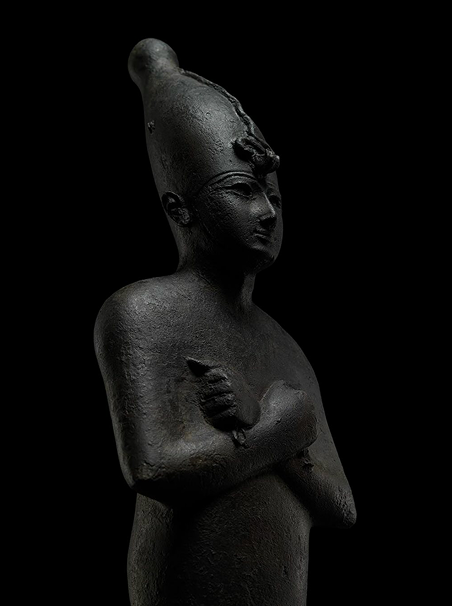
The Hultmark Horus


 Enquire
A supremely fine figure of the Egyptian god Horus in the form of a falcon. It is exquisitely crafted from bronze, with an unusually high level of detail. The gently rounded head smoothly merges into the feathers of the back, extending into a V-shaped tail, giving the piece an elegantly balanced silhouette. The facial features are highly lifelike, with rounded eyes framed by a thin raised eyelid and an almond-shaped socket. The extension of the eye lid at the outer corners of each eye recalls the apotropaic wedjat-eye, or Eye of Horus. The beak is similarly detailed, even featuring the pointed overhang of the falcon’s upper mandible. The naturalistic treatment of the bird continues in the soft curves of its breast, demonstrating the expert abilities of the artisan who produced it. The falcon’s feathers are individually incised, centring around the crown of the head and flowing outwards down the back. The back feathers are each represented by overlapping c-shaped curves, with individual barbs picked out as small angled lines running down a triangular central shaft. The falcon’s wings are folded across its back, with the longer flight feathers differentiated into their primary and secondary layers of remiges. The tips of the wings cross over the tail symmetrically, with sharply defined edges adding further dimension. The tail feathers are similarly incised, again as the retrices are found in life, in a single horizontal row. Below the crural feathers, which end in slightly rounded points behind the two legs, the ridged texture of the legs and feet is represented through deeply incised lines. The three front toes and shorter back toe are each surmounted by a sharp, viciously curved claw. It stands on a flat square base. The remains of three projecting rods on the base of the Horus (two beneath the base and one in the centre of the tail) suggest it may have originally been affixed to something. The bronze is hollow, with an accessible opening beneath the back and tail.
Horus, the son of the goddess Isis and the god Osiris, was one of the most important gods in the Egyptian pantheon. He was worshipped from at least late prehistoric Egypt until the Ptolemaic and Roman Periods. His battle to regain his throne from his uncle Seth, who had killed his father Osiris, was viewed as symbolic of the pharaoh’s vanquishing of Egypt’s enemies, and he was seen as the uniter of the Two Kingdoms of Egypt and the maintainer of order. He therefore represented the concept of balance, which was highly valued by the Egyptians. As such, he was associated with kingship and the pharaoh came to be viewed as a representation of Horus on earth. The Pyramid Texts (c. 2400-2300 B.C.) describe the pharaoh as embodying Horus in life and Osiris in death – when one pharaoh died their successor was Horus’s new incarnation. During his battle with Seth, one of Horus’s eyes was gouged out – the Eye of Horus, or wedjat-eye, was a powerful apotropaic symbol for ancient Egyptians.
Following his victory over Seth, Horus became known as ‘Horus the Great’ or ‘Horus the Elder’. This is written in hieroglyphs as ḥr.w, or ‘falcon’, 𓅃, and is also translated as ‘the distant one’ or ‘one who is above, over’. Horus was often depicted as a falcon or a man with a falcon’s head. The falcon, therefore, came to symbolise divine kingship in itself, and is often depicted wearing the Double Crown of Egypt or the sun disc in statues and paintings. Horus was also god of the sky, with the sun as his right eye and the moon as his left. In his falcon form, Horus flew the sun and moon in their journey across the sky, with outspread wings protecting the earth below.
From the Late Period onwards, sacred animals became a focus for ancient Egyptian worship in the form of mummies and votive offerings. The animals were worshipped as a living incarnation of a god on earth. They would often be kept in the precinct of their associated deity’s temple, where they would live a life of great luxury. Several industries supported the animal cults, with keepers, embalmers, and builders constructing the dedicated necropoleis, as well as the priests who managed the donations. Entire complexes of buildings dedicated to falcons of Horus have been found at Saqqara, Buto, Abydos, and Kom Ombo. Pilgrims who visited these temples would purchase falcons to be mummified and presented as signs of devotion to the god, or when seeking a particular blessing. Their offerings would then be interred in the catacombs as an eternal prayer to Horus. The falcons were treated with the same reverence in death as in life: they were carefully mummified with bandages overlaid in elaborate patterns and often with painted cartonnage masks, as seen in examples now in the Michael C. Carlos Museum, Atlanta (1958.063 and 2005.040.002) and the Museum of Fine Arts, Budapest (98.4-E). They would also be buried in their own carefully-crafted coffins.
Bronze statuettes would either have stood atop a box coffin or, like this example, served as a coffin itself. The hollow-cast bronze creates an inner compartment in which a mummified falcon could be deposited via an opening in the base of the statuette. This cavity would then have been sealed with a bronze plate. Hundreds of thousands of falcon mummies were interred at animal necropoleis and sacred sites for the solar cult throughout Egypt. This form of worship continued into the Graeco-Roman period, as evidenced at the temples at Philae and Edfu. This bronze falcon is, therefore, a material record of an ancient pilgrim’s prayer.
Emil Hultmarks Samling, Kungliga Akademien för de fria konsterna, Stockholm, 1942, no. 596.
Maj Sterner, ‘Fil. dr. och fru Emil Hultmarks hem. Birger Jarlsgatan 32, Stockholm’, Svenska Hem I Ord Och Bilder, ed. Stig M H-son Björkman (1936), p. 176.
Emil Hultmarks Samling, Kungliga Akademien för de fria konsterna, Stockholm, 1942, no. 596, p. 73, pl. 34.
Private Collection of Dr. Emil Hultmark (1872-1943), Birger Jarlsgatan 32, Stockholm, from at least 1936.
Thence by descent (accompanied by Swedish export licence).
ALR: S00253479, with IADAA Certificate, this item has been checked against the Interpol database.
Dr. Emil Hultmark (1872-1943) was an art historian, collector, donor, and patron of the arts. As well as undertaking important research as an art historian, he gathered one of the largest private art collections in Sweden. He studied at the university of Upsala from 1892 to 1897, and then spent nine years travelling round England, France, Germany, Italy, and Switzerland. He undertook further studies under art historians Heinrich Wöfflin and Adolph Goldschmidt at the university of Berlin, as well as the universities of Vienna and Bern. He defended his thesis on Swedish painter Carl Frederik von Breda in 1906, and published it alongside a catalogue of portraits, featuring several previously unknown paintings by the artist.
After Hultmark settled in Stockholm, his large inherited fortune enabled him to compile a collection of huge breadth: containing paintings, sculptures, engravings, furniture, textiles, silver, bronzes, and faience. His collection was particularly strong in Swedish and Chinese art. He also assembled a formidably large archive of Swedish artists and craftsmen, and a library covering the entire history of Swedish art. The 1936 magazine article on his home states that ‘It is an experience to enter a home, where art is worshipped for its own sake and is enjoyed in a way that shows the best and truest understanding of its aesthetic value’.3 He was one of the co-founders of the Kinaklubben (China Club) in Stockholm in the 1920s, alongside Carl Kempe (1884-1967) and the Crown Prince Gustav Adolf. He was also an important patron of Swedish artists, and his generous donations to the Östasiatiska Museet, Stockholm, and the Nationalmuseum, Stockholm, allowed them to expand their collections. He also donated to the Royal Academy of Arts and the Swedish Institute.

 Established 1910




 Where to find us?
 Newsletter
 Instagram
 Linked in
 Email
Email