Northern Cardinal Figure


Northern Cardinal Figure
H: 16 cm
Wood statuette on unbaked clay base
Egypt
Circa 1428-1397 B.C., Reign of Amenhotep II, 18th Dynasty, New Kingdom,
Sold
 Enquire
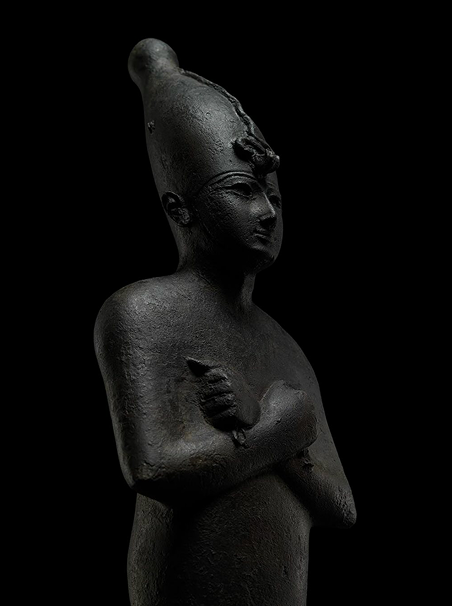
A wooden figure of a man in striding pose, with true left foot forwards and arms held straight by his sides. The figure wears a short loincloth and a long tripartite wig. The rounded face is carved with a broad nose and mouth; the eyes with extended cosmetic lines and the eyebrows are outlined in black paint. The large ears protrude on either side of the face, in front of the wig. The body is modelled softly, with a pronounced curve inwards at the waist, subtly suggested pectorals and slightly rounded stomach. The figure is mounted on a rectangular base of unbaked clay, which is painted with white hieroglyphs on the upper side and black hieroglyphs on the front, forming a prayer for Outkaou, the owner of the tomb in which this figure was placed. It is unusual for a wooden figure of this time to have been carved out of one block of wood, as is the case for this example – this demonstrates a high level of skill from the craftsman who made it.
Wooden figures such as this were interred within tombs and burial shafts throughout ancient Egyptian history. The white hieroglyphic inscription identifies the figure as a personification of the North, as part of a known but uncommon practice of placing statuettes embodying the four cardinal points within the burial chamber. Such figures have been found both on top of the coffin and on the floor surrounding it. Although most popular in the Middle Kingdom (2040-1782 B.C.), wooden models were still in use in the New Kingdom – Tutankhamun’s tomb held 35 wooden boats and associated figures. The proportions of the figure, with the emphasised waist and shorter torso, are consistent with the proposed 18th Dynasty dating. The intact unfired clay base rarely survives from antiquity, due to its delicate material, making this a rare example of its kind.
Collection A. Raifé. Antiquités, Monnaies & Médailles, Hôtel Drouot, Paris, 18-25 March 1867, p. x, Lot 316.
Previously in the Private Collection of Adolphe Raifé (1802-1860), 9 rue de Lille, Paris, by at least 1860, with handwritten collection label on base.
Thence by descent to his son-in-law Gustave Gosset (1826-after 1860), 9 rue de Lille, Paris.
Private Collection of Julien Bessonneau (1842-1916), Angers.
Thence by descent.
Private Collection of Jean-Pierre (b. 1936) and Liliane (1940-2016) Leveilley, Angers, acquired from the above in the 1970s or 1980s.
ALR: S00259874, with IADAA Certificate, this item has been checked against the Interpol database.
Adolphe Raifé (1802-1860) was born in Paris in 1802 and studied Near Eastern languages at L’école des Jeunes de langues, with a focus on Arabic. Described in his early life as an artist, with a handful of surviving engravings and lithographs attesting to this, Raifé began collecting art, antiques, books, and prints at the age of eighteen.1 He pursued his interests as an amateur archaeologist, travelling to the Near East with his brother at the start of 1921; first visiting Greece and then arriving in Istanbul (then Constantinople) during uprisings that formed part of the Turkish War of Independence (1919-1923). The brothers became involved in a street fight and had to launch a swift retreat, while injured, onto a ship returning to France immediately. However, Alphonse’s brother died of his injuries upon their return.
Raifé resumed his travels in 1824 and 1825, when he journeyed through Italy. He spent a long time in Rome, living with a colony of artists, includes Ingres and Léopold Robert. He continued on to Wallachia (a region of modern-day Romania), Bulgaria, Serbia, and Albania – all regions that were rarely visited by Europeans in those days and a far broader scope of travel than that covered by the standard Grand Tour. Raifé also returned to Greece and Turkey, and then into Syria and Egypt. He acquired many of the antiquities in his collection during his travels, and made several detailed studies and sketches of the sites he visited.
After his return to Paris, Raifé devoted his attentions to his collection. He first focused exclusively on acquiring rare books and prints for several years, before focusing on antiquities and art from the Middle Ages and the Renaissance in the final two years of his life. He acquired pieces from auction houses and dealers in Paris, aiming to establish a collection which could represent a full history of art from ancient to modern times, spanning from Egypt to America. He kept his collection at his home on 9 rue de Lille, where he studied it and supplemented his notes by consulting the books in his expansive library.
Following his death in 1860, the collection was inherited by his son-in-law, Gustave Gosset (1826-after 1860). It was kept in Raifé’s Parisian townhouse and gradually dispersed during a series of public sales between 1863 and 1867. The antiquities collection remained intact until the 18-27 March 1867 sale at the Hôtel Drouot, Paris. The Assyriologist and Archaeologist François Lenormant was the expert for the sale and wrote the catalogue, which was intended as a lasting record of Raifé’s extensive collection, rather than a simple note of the sale. The catalogue featured twelve woodcuts by the artist Adrien Féart, reproducing some of the works in the collection. The sale was attended by dealers, such as Claude Camille Rollin, and well-known collectors, including Louis de Clercq and Arnold Morel-Fatio. Museums were also represented, with the Louvre acquiring fifteen objects from the Egyptian collection through the curator Emmanuel de Rougé. The British Museum acquired nine Egyptian lots from the sale through an intermediary. In total, the 1867 sale drew in 41,404 francs.
Julien Bessonneau (1842-1916) was born on 21 March 1842 in Saint-Clément-de-la-Place, Angers, to a wealthy family of farm-owners and industrialists. He married the daughter of François Besnard in 1869, and began working with Besnard’s rope and string company, Corderie du Mail. This company became Établissements Bessonneau, a linen and hemp-weaving company, which made Bessonneau the leading industrialist in Angers in the 1870s. By the start of the First World War, one in sixteen Angers residents worked for Bessonneau’s company. In 1876, he became mayor of Saint-Clément-de-la-Place, a position which he held until his death in 1916. Bessonneau provided logistical and financial support for René Gasnier’s aeronautical endeavours, installing large tents to protect the aeroplanes at races and helping to organise events. Bessonneau also established a relief fund for workers, nurseries, a musical band, and sports facilities – including a football club which became today’s Angers SCO, and their home stadium (now known as Stade Raymond-Kopa).
Bessonneau had two impressive residences in Angers – Château des Brosses and Château des Múrs, one wing of which was dubbed the ‘museum’ – and a Parisian residence on rue de Constantine. Here, he displayed his large collection of ancient and modern paintings, decorative arts, sculptures, African and Oceanic art, and antiquities. A 1916 inventory of his estate reveals the extent of his holdings, listing items such as ‘one hundred vases and objects from Cyprus, Greece, and Phoenicia’, and ‘forty Gallo-Roman vases’. Bessonneau kept meticulous records of his collection, including his purchase invoices from notable dealers such as the Indjudjian brothers and Georges Monolakos, some notes regarding intermediaries he used, and a few auction sales slips.
After Bessonneau’s death on 4 August 1916, his heirs did not expand the collection any further, and the objects were steadily dispersed at various sales, including a 1956 auction of a group of paintings.
Jean-Pierre Léveilley (b. 1936) was born into a family of industrialists and property owners in Algeria (then the French department of Algiers) in 1936. The Léveilley family ran successful furniture factories in Bordeaux and Algiers from the end of the nineteenth century onwards, and developed an interest in art, particularly Orientalist paintings. Léveilley studied at l’École nationale des Beaux-Arts d’Alger in the 1950s, before joining the family business. He enlisted in the army, married Liliane (1940-2016) in 1962, and received a departure of no return in 1965. The couple settled in Angers in 1965, and ran the thriving antique store ‘Au coin du feu’ on the rue Toussaint for the next forty years. They established a strong network of sellers and buyers, allowing them to build their personal collection of anything and everything that interested them. Jean-Pierre was said to learn and collect as quickly as he bought and sold. Some notable customers include the esteemed collectors Jacques Deschamps and Alex Brunet.
In the 1970s and 1980s, Léveilley took advantage of the opportunity to acquire a large part of Bessonneau’s archaeology collection. They patiently continued to acquire objects from Bessonneau’s collection until the early 2020s, when Jean-Pierre donated 324 pieces to the city of Angers in October 2023. These pieces, including paintings by Gérôme and Isabey, Native American ceramics and objets d’art and historical objects from the Anjou region, as well as large numbers of Greek, Roman, Phoenician, Mesopotamian, and Egyptian antiquities, are now distributed between two local museums.

 Established 1910




 Where to find us?
 Newsletter
 Instagram
 Linked in
 Email
Email