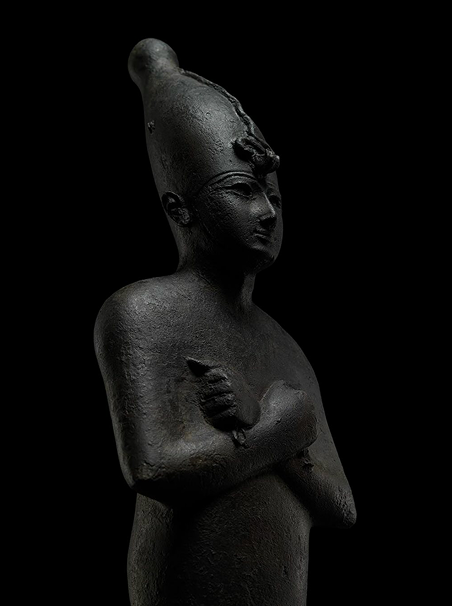
Polytheistic Figure


Polytheistic Figure
664-343 B.C., 26th-30th Dynasty, Late Period, Egypt
Bronze
H: 22.9 cm
Sold
 Enquire
A bronze figure of an ancient Egyptian syncretic deity. The god is largely humanoid in form, standing naked with dramatically bowed legs, and large, bat-like wings held aloft by the arms of Nut on either side of his back. In his right hand he originally held a snake, which is now damaged. The god’s body is adorned by a series of animal heads: a hawk wearing the solar disc on the true right shoulder; a lion with solar disc on the left shoulder; a scarab in the centre of the ribs; and a cat head at the end of the erect phallus. He wears a long false beard and a very large headdress, which is roughly as tall as the rest of the figure. The basis of the headdress is the plumed Atef crown, with horizontal ram horns at the base and a central uraeus. The solar disc sits between the long ostrich plumes, and the crown is surmounted by the lunar disc. The crown is incised with the jackal head of Anubis on the front, between the discs. The head of the Apis bull projects from the back of the god’s human head. The figure’s feet rest on the backs of two crocodiles embedded in the top of the pedestal, while two long serpents coil around them. The head of a jackal is modelled in relief on the rear of the pedestal. The figure appears to have originally been gilded.
This figure fuses the attributes of many different gods into one polytheistic deity. Earlier descriptions have identified the statuette with Ptah-Sokar-Osiris, a powerful triad of Sokar, god of the Mephite necropolis, Ptah, the creator god of Memphis and god of craftsmen, and Osiris, the king of the underworld. Other allusions to the chthonic deities of Anubis and Apis are also incorporated. The figure also features certain elements of the bow-legged dwarf god Bes, and the child-god Horus-Shed (‘Horus the Saviour’), who is commonly depicted standing atop two crocodiles and holding serpents by their tails. This fusion of attributes suggests that the figure was meant to hold strong apotropaic properties, with dominion over both the land of the living and the dead.
F. G. Hilton Price, A Catalogue of the Egyptian Antiquities in the Possession of F.G. Hilton Price (London, 1897), no. 3771, pp. 447-448.
Catalogue of the Important and Extensive Collection of Egyptian Antiquities. The Property of the late F.G. Hilton Price, Esq., Sotheby, Wilkinson & Hodge, London, 12-21 July 1911, Lot 299, p. 40.
Catalogue of the Remaining Part of the Valuable Collection of Egyptian Antiquities formed by Robert de Rustafjaell, Esq., Sotheby, Wilkinson & Hodge, London, 20-24 January 1913, Lot 495.
Previously in the Private Collection of Frederick George Hilton Price (1842-1909), London, acquired shortly before 1897, until 1911.1
Private Collection of Robert de Rustafjaell (1876-1943), Luxor, by at least 1913.
Private West Coast Collection.
ALR: S00267390, with IADAA Certificate, this item has been checked against the Interpol database.
Frederick George Hilton Price (1842-1909) was born in Dalston, London, the eldest child of Frederick William Price, a senior partner in the banking firm Child & Co. He attended Crawford College, Maidenhead, and started working for Child & Co. (now a part of the NatWest Group) in 1867. He was promoted to partner in 1887, and senior acting partner in 1901, a position he held until his death in 1909. He researched the history of the bank and published two studies of his findings in 1875 and 1877. His main interest was, however, in the field of archaeology. He formed several collections of antiquities, including Stone Age, Bronze Age, Roman, and Samian objects. He also collected English pottery, medieval ink horns, coins, and spoons. Price took a leading role in the excavation of the Roman villa at Brading in the Isle of Wight, which he worked to keep open to the public for some time.
He also presented papers to the Royal Institute of British Architects, the Society of Antiquaries, and the Society of Biblical Archaeology. Several items from his Egyptian collection were exhibited at the 1895 exhibition of the Burlington Fine Arts Club, and Price published two extensive illustrated catalogues of his Egyptian pieces in 1897 and 1908. In 1905 he was elected president of the Egypt Exploration Fund, and he also served as a fellow of the Royal Geographical Society, vice president and treasurer of the Anthropological Institute, president of the London Topographical Society, treasurer of the Geologists Association, fellow and vice president of the Zoological Society of London, fellow and president of the Royal Numismatic Society, and council member and vice president of the Society of Biblical Archaeology.
Hilton Price married Christina Bailey, daughter of William Bailey of Oaken, Staffordshire, in 1867, and they had a son and a daughter together. Price died following an operation in Cannes on 14 March 1909, and was buried in Finchley. Posthumous sales of his collections of books, coins, old spoons, and artworks brought in £2,606 10 s 6d, while his Egyptian collection alone sold for £12,040 8s 6d at the 1911 Sotheby’s sale.
Robert de Rustafjaell (1876-1943) was born in St. Petersburg, Russia, on 10 December 1859, the son of Norwegian engineer Nicholas Classen Smed and Maria Tamara Orbeliani. Rustafjaell told many different stories about his biography, none of which can be externally verified. In later versions of his bibliography he claims to have been born in Birmingham, or to have been brought to England in 1861, for an education at Harrow and Oxford, Sweden, and Germany. From 1877, Rustafjaell travelled in America, and returned to England in 1887. He was first known by the surname Smith or Fawcus-Smith, but as using Rustafjaell by at least 1892 (he formally changed his name on 9 October 1894). He seems to have married Swedish woman Carolina Amalia Arfwidson in 1892, with whom he had one son, and was remarried to Harriet Sarah Wilkinson in 1895. By 1905 he had married again, this time to American Mary Davis, who may have been the mother of his daughter Tamara.
Rustafjaell excavated at Cyzicus in Turkey in 1901, and then lived in Egypt for some time. Here he worked as a geologist, mining engineer and owner of the Luxor Trading Co., which dealt in antiquities. In 1909 he opened an antiquities shop called the Museum of Practical Archaeology in the main street in Luxor. Rustafjaell was elected a Fellow of the Royal Geographic Society in 1899, the Zoological Society in 1901, and the Royal Numismatic Society in 1904. He formed an expansive collection of Egyptian antiquities, including two large batches of papyrus rolls and codices from Aswan and Edfu, a cache of well-preserved textiles from the Hathor sanctuary at Deir el-Bahri, reliefs from the walls of Theban tombs, and many Predynastic objects. He published many short notices on his collection in newspapers and journals, and authored several books on the topic. In 1914, Rustafjaell was declared bankrupt in London and emigrated to America. Much of his collection was put up for auction at Sotheby’s in 1906 and 1907. Further sales of his collection were held in London in 1913, Paris in 1914, and New York in 1915, as well as a post-humous one in New York in 1949. Sir Henry Solomon Wellcome bought many pieces from these sales, and many of works from Rustafjaell’s collection are now in the British Museum, British Library, Berlin Museum, and the Louvre. Rustafjaell, who went by Col. Prince Roman Orberliani later in life, died in New York on 10 February 1943.

 Established 1910




 Where to find us?
 Newsletter
 Instagram
 Linked in
 Email
Email