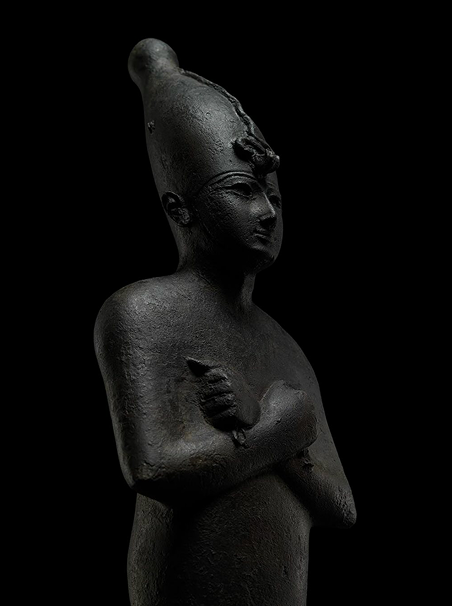
Stele of Thutmose IV


Stele of Thutmose IV
C. 1417-1407 B.C., Reign of Thutmose IV, 18th Dynasty, New Kingdom, Egypt
Limestone
H: 69 cm, L: 46 cm
Sold
 Enquire
A round-topped limestone stele for Pharaoh Thutmose IV. The stele depicts the pharaoh on the right-hand side with both arms extended bearing offerings of plants. The pharaoh sports the uraeus serpent, symbol of sovereignty, on his brow. Receiving the offerings on the left stands the god Atum, wearing the double crown of Upper and Lower Egypt, or pschent. In his right hand he holds an ankh and in the other the was sceptre. His name is inscribed in hieroglyphs above him. In the centre of the row of incised hieroglyphs are two cartouches recording the name (‘Djehutimes’ or Thutmose) and prenomen (‘Menkheperure’) of the pharaoh. A winged sun disc sits at the top of the composition, with wings outstretched over the scene.
Thutmose IV (r. c. 1401-1391 or 1397-1388 B.C.) was the eight pharaoh of the 18th Dynasty. His prenomen (royal name) was Menkkheperure, meaning ‘Established in forms is Re’. He is best known for his restoration of the Great Sphinx of Giza and subsequent commission of the Dream Stele. Thutmose IV was the son of previous pharaoh Amenhotep II and Tiaa, but he was not Amenhotep’s chosen successor. It has been theorised that Thutmose usurped his older brother in order to claim the throne, and that the magnificent Dream Stele was designed to consolidate his rule. The large, round-topped granite stele (also known as the Sphinx Stele) was positioned between the front paws of the Great Sphinx of Egypt during the first year of Thutmose’s reign. The stele is 3.6 metres tall and originally formed the back wall of a small open-air chapel. It depicts Thutmose making offerings and libations to the Sphinx. The inscription tells that Thutmose was granted kingship by the Sphinx itself, as a reward for clearing the sands that had risen around its base. He also added an inscription on the body of the Sphinx, recording that the pharaoh found a stone in the shape of the divine falcon of Horus as a child.
During his reign, Thutmose IV established peace between Egypt and their former rival Mitanni, and married a Mitannian princess to secure the alliance – the princess would go on to become his principal consort, queen Mutemwiya. He was also responsible for many grand architectural projects across Egypt, including the completion of the eastern obelisk at the Temple of Karnak. At 32 metres tall, this was the largest obelisk ever erected in Egypt, and it would later be transported to the Circus Maximus in Rome by Emperor Constantius II in 357 A.D., and then to the Piazza San Giovanni by Pope Sixtus V in 1588. Thutmose also constructed a unique chapel and peristyle building on the eastern walls of the main Karnak temple building. This was a place where the common people, who were not allowed into the temple itself, could address their prayer to the god Amun. Thutmose IV is also depicted in numerous portraits, although many were later coopted by Ramesses II. After a roughly ten-year reign, Thutmose died and was succeeded by his son, Amenhotep III.
Previously in the Private Collection of Ben Weider (1923-2008), Montréal, Canada, presented to him by the United Arab Republic of Bodybuilding Federation for his work in popularising bodybuilding in the Middle East, in March 1964, Cairo, and kept in his office in Montreal until it was moved to storage in 2015.
ALR: S00261886, with IADAA Certificate, this item has been checked against the Interpol database.
Ben Weider (1923-2008) was born on 1 February 1923 in the old Jewish immigrant quarter of Montréal, Canada, as the third son of Polish immigrants. At the age of 13, Weider left school to begin working in restaurants and factories. In 1942, he enlisted in the Canadian Army and performed intelligence works as a member of the 6th Duke of Connaught’s Royal Canadian Hussars. He also fought in the Canadian Army in the Second World War.
With his brother Joe, Weider is credited with established bodybuilding as a sport, founding the Mr. Olympia contest at the Brooklyn Academy of Music in 1965. In 1968 the brothers brought then-unknown Austrian bodybuilder, Arnold Schwarzenegger, to California.
They cofounded the International Federation of BodyBuilding & Fitness (IFBB), and Weider served as president until his retirement in 2006. The brothers also established a weightlifting magazine Your Fitness, which rapidly expanded to include other titles such as Flex, Muscle & Fitness, Men’s Fitness and Fit Pregnancy, and ran a physical fitness and sporting goods business in Montréal. Weider also opened several gyms around the world, including in Lebanon.
This stele was gifted to him by the United Arab Republic of Bodybuilding Federation in order to recognise his work promoting bodybuilding as a sport in the Middle East.
Weider was made a Member of the Order of Canada in 1975, a Knight of the National Order of Quebec in 2000, a Knight of the French Legion of Honour in 2000, a member of the Quebec Sports Hall of Fame, and a Commander of the Venerable Order of St. John. In 1984, he was also nominated for the Nobel Peace prize.
Weider also founded the International Napoleonic Society and co-authored several Napoleonic history books, including The Murder of Napoleon – now one of the best-selling history books of all time. He was a known advocated for the theory that Napoleon was assassinated by a member of his entourage during his exile in Saint Helena. Weider obtained samples of Napoleon’s hair and had them sent for forensic testing, which showed that the emperor had been poisoned using arsenic. He also owned an extensive collection of Napoleonic memorabilia, which he donated to the Montréal Museum of Fine Arts, making it one of the largest collections of its kind in the world.
Weider died on 17 October 2008 in Montréal. His and his brother’s lives were the subject of the 2018 American comedy-drama film Bigger.

 Established 1910




 Where to find us?
 Newsletter
 Instagram
 Linked in
 Email
Email